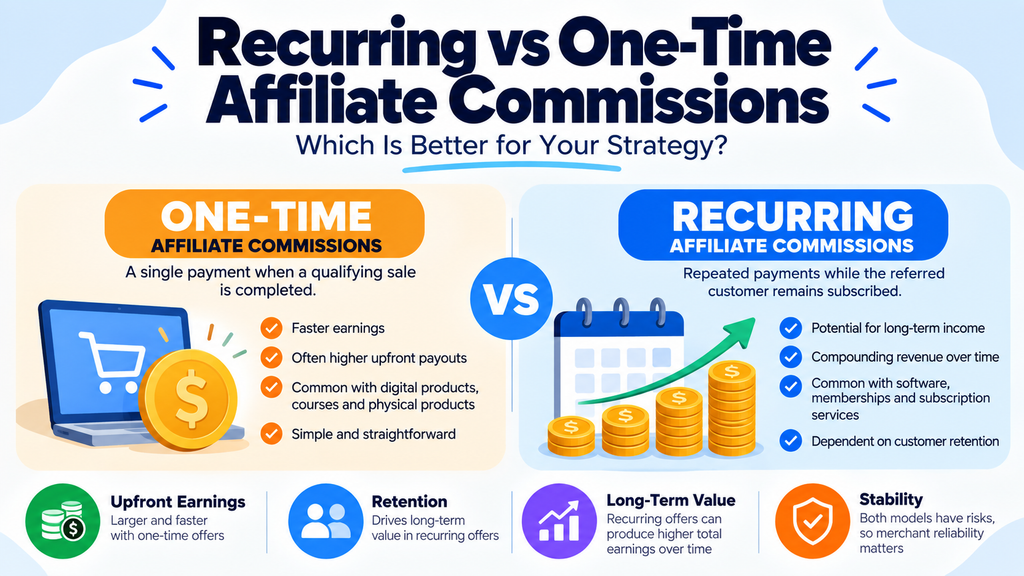
Affiliate programs do not all pay commissions in the same way.
Some pay once for a completed sale.
Others continue paying for as long as the referred customer remains subscribed.
That distinction can significantly affect how an affiliate evaluates an offer.
Understanding recurring vs one-time affiliate commissions helps you compare short-term earnings with longer-term income potential, customer retention, payout reliability, and overall program quality.
Neither model is automatically better.
If you’re new to affiliate marketing, our beginner’s guide explains the broader model before you compare commission structures.
The stronger choice depends on the product, the audience, the merchant, and the economics behind the offer.
What Is a One-Time Affiliate Commission?
A one-time affiliate commission is paid once when a qualifying transaction is completed.
The affiliate may receive:
- a fixed amount,
- a percentage of the sale,
- or a tiered commission based on performance.
Once that commission is paid, the referral generally does not generate additional income unless the customer makes another qualifying purchase.
One-time commissions are common with:
- digital products,
- courses,
- physical products,
- software licences,
- events,
- and many ecommerce offers.
What Is a Recurring Affiliate Commission?
A recurring affiliate commission is paid repeatedly while the referred customer continues paying for the product or service.
This is common with:
- software subscriptions,
- memberships,
- hosting,
- recurring services,
- SaaS products,
- and online platforms.
For example, if a program pays 30% recurring commission on a $50 monthly subscription, the affiliate may receive $15 each month while the customer remains active and the program terms remain unchanged.
The Core Difference
The simplest distinction is:
One-time commission: you are paid once.
Recurring commission: you may continue to earn from the same referral over time.
That makes recurring commissions attractive, but the long-term value depends heavily on customer retention.
Why One-Time Commissions Can Be Attractive
One-time commissions are straightforward.
The affiliate knows what the payout is when the sale occurs.
Advantages may include:
- faster earnings,
- simpler tracking,
- larger upfront payouts,
- less dependence on customer retention,
- easier performance forecasting.
Some one-time programs also pay substantial commissions on higher-priced products.
A single sale may therefore be worth more than several months of recurring commissions.
Why Recurring Commissions Can Be Attractive
Recurring commissions can create a compounding effect.
If customers stay subscribed, each new referral may add another stream of commission income.
Over time, this can produce a more stable revenue base.
Recurring commissions are especially appealing when:
- the product has strong retention,
- customers use it regularly,
- cancellation rates are low,
- and the merchant maintains a reliable affiliate program.
The Importance of Customer Retention
Recurring commissions only work well if customers remain active.
A program advertising recurring income may sound attractive, but poor retention can reduce the real value quickly.
For example:
A 30% recurring commission sounds strong.
But if most customers cancel after one month, the recurring benefit is limited.
By contrast, a lower recurring percentage can be very valuable if customers stay for a year or longer
Understanding how affiliate marketing works also helps explain why tracking, attribution, and customer retention matter so much to recurring commissions.
Customer Lifetime Value
Customer lifetime value helps explain why recurring programs can be powerful.
Suppose a customer pays $40 per month and remains subscribed for 12 months.
Total revenue from that customer is:
$480
If the affiliate receives 25% recurring commission, the total affiliate earnings could be:
$120
That may be much more valuable than a one-time $40 commission.
But if the customer cancels after two months, the affiliate earns only:
$20
The retention pattern changes the economics completely.
One-Time Commissions and Higher Ticket Offers
One-time commissions can be especially attractive with higher-priced products.
For example, a 40% commission on a $500 product produces:
$200
An affiliate would need many months of smaller recurring payments to equal that amount.
This is why the best commission structure cannot be judged by recurring versus one-time alone.
The actual numbers matter.
Compare Total Value, Not Just Percentage
Affiliates often compare commission percentages without considering the underlying product price.
For example:
Offer A: 50% of $20 = $10
Offer B: 20% of $200 = $40
Offer B pays a lower percentage but a higher commission.
The same principle applies when comparing recurring and one-time offers.
Focus on expected total value, not headline percentages.
Cash Flow Differences
One-time commissions usually generate income sooner.
Recurring commissions may build more slowly.
That creates different cash-flow patterns.
One-Time Model
Income may be:
- faster,
- less predictable month to month,
- dependent on constant new sales.
Recurring Model
Income may be:
- slower initially,
- more stable over time,
- dependent on retention.
Neither pattern is inherently better.
Recurring Revenue Is Not Guaranteed
Recurring commissions are often marketed as “passive income.”
That description can be misleading.
Recurring earnings may stop because:
- the customer cancels,
- the customer fails to pay,
- the merchant changes the program,
- commission rates are reduced,
- the affiliate program closes,
- the merchant changes tracking,
- or the product is discontinued.
Recurring commissions should be treated as ongoing opportunity, not guaranteed income.
Program Terms Matter
Two recurring programs can have very different structures.
One may pay:
30% recurring for life
Another may pay:
30% recurring for 12 months
Another may pay:
20% recurring only while the affiliate remains active
Always read the terms carefully.
Commission terms can also vary depending on whether an offer is managed through an affiliate network or an independent program.
Refunds and Reversals
Both one-time and recurring commissions can be affected by refunds and reversals.
With one-time programs, a refunded sale may cancel the commission.
With recurring programs, cancellations may stop future commissions.
This is why reversal and churn rates matter.
Merchant Stability Matters More for Recurring Programs
Recurring commissions depend heavily on the merchant remaining stable.
If the company experiences:
- financial problems,
- declining product quality,
- poor customer service,
- high churn,
- or program changes,
the affiliate’s future earnings may fall.
That makes merchant reliability especially important.
Which Model Is Better for Beginners?
For beginners, one-time commissions can be easier to understand.
The sale happens, the commission is recorded, and the transaction is complete.
Recurring programs can also be excellent for beginners, especially when promoting tools or services with obvious ongoing value.
The key is not complexity.
It is product fit and reliability.
Which Model Is Better for List Building?
Recurring programs can work especially well with email marketing.
Why?
Because email allows the affiliate to:
- educate leads,
- follow up,
- recommend related tools,
- support customers,
- and build long-term relationships.
A list can therefore support recurring offers over time.
But one-time offers can also perform very well when matched to clear buyer intent.
Which Model Is Better for Content Sites?
Content sites can use both.
Evergreen tutorials and reviews may support recurring software offers.
Comparison articles may support one-time purchases.
A diversified content strategy can include both structures.
A Hybrid Approach
Many affiliates do not choose only one model.
They combine:
- one-time commissions for immediate revenue,
- recurring commissions for longer-term income.
This creates a more balanced portfolio.
For example, an affiliate might promote:
- a one-time course,
- a recurring email platform,
- a one-time digital product,
- and a recurring hosting service.
How to Compare the Two Models
When evaluating recurring vs one-time affiliate commissions, compare:
| Factor | One-Time | Recurring |
|---|---|---|
| Payment timing | Usually faster | Spread over time |
| Dependence on retention | Low | High |
| Income stability | Can fluctuate | Can build gradually |
| Upfront payout | Often larger | Often smaller |
| Long-term potential | Limited per sale | Potentially higher |
| Program risk | Lower after payment | Ongoing |
| Forecasting | Simpler | Depends on churn |
| Merchant stability | Important | Very important |
Questions to Ask Before Choosing
Before selecting an offer, ask:
- How much is the upfront commission?
- How much is the recurring commission?
- How long do recurring payments continue?
- What is the average customer retention period?
- What is the refund rate?
- What is the churn rate?
- Is the merchant reliable?
- Are payments consistent?
- Can the program change terms easily?
- Does the product fit my audience?
How This Connects to Offer Selection
As discussed in How to Choose an Affiliate Offer, commission structure is only one part of the decision.
A recurring offer with poor retention may be weaker than a strong one-time offer.
A high-ticket one-time product may outperform a low-value subscription.
Audience fit, product quality, tracking, conversion, and merchant reliability still matter.
When One-Time Commissions May Be Better
One-time commissions may be more attractive when:
- the upfront payout is high,
- the product converts strongly,
- the merchant is reliable,
- the buyer intent is strong,
- and repeat billing is not necessary.
When Recurring Commissions May Be Better
Recurring commissions may be more attractive when:
- customers stay subscribed,
- the product solves an ongoing problem,
- retention is strong,
- the program is stable,
- and the audience uses the product long term.
A Practical Strategy
A balanced strategy might look like this:
Use one-time offers for cash flow.
Use recurring offers for longer-term income.
Track real earnings rather than relying on advertised rates.
Promote only products that fit the audience.
Diversify across several reliable programs.
That approach reduces dependence on any single commission model.
Final Thoughts
Recurring vs one-time affiliate commissions is not really a question of which model is universally better.
It is a question of economics.
A good one-time offer can outperform a weak recurring offer.
A strong recurring program can produce far more long-term value than a single payout.
The most important factors are:
- audience fit,
- product quality,
- customer retention,
- merchant reliability,
- conversion,
- and actual earnings over time.
The strongest affiliate strategy usually focuses less on labels and more on what the numbers show.