
Affiliate marketing depends on one essential question:
Who should receive credit for the referral?
That is the job of affiliate tracking.
Without reliable tracking, merchants would struggle to know which affiliate generated a click, lead, or sale, and affiliates would have no dependable way to measure performance or receive commissions.
Understanding affiliate marketing tracking helps explain how clicks become commissions, why cookies matter, how attribution works, and why some referrals are not recorded perfectly.
What Is Affiliate Marketing Tracking?
Affiliate marketing tracking is the system used to identify and record referrals generated by an affiliate.
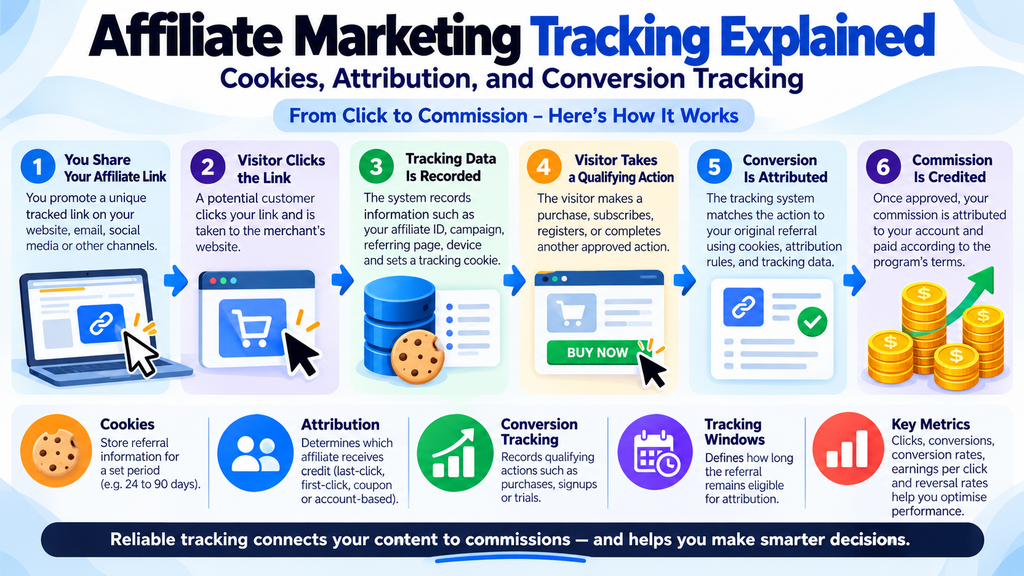
When someone clicks an affiliate link, the tracking system may record information such as:
- affiliate ID
- campaign ID
- referring page
- date and time
- device or browser information
- tracking cookie
- conversion data
The goal is to connect a later action, such as a purchase or signup, back to the affiliate responsible for the referral.
The Basic Tracking Process
A simplified affiliate tracking sequence looks like this:
Affiliate shares a tracked link → Visitor clicks → Tracking data is recorded → Visitor takes a qualifying action → Conversion is attributed → Commission is credited
The exact technology varies by platform, but the underlying purpose remains the same.
For a broader view of how affiliate marketing actually works from referral to commission, see our step-by-step guide.
What Is an Affiliate Link?
An affiliate link is a URL containing information that identifies the affiliate.
A normal product URL might look like:
example.com/product
An affiliate version might include additional tracking information:
example.com/product?ref=12345
That identifier allows the merchant or affiliate network to associate the visitor with a particular affiliate.
Some platforms use more complex links, but the principle is similar.
What Happens When Someone Clicks an Affiliate Link?
When a visitor clicks the link, several things may happen almost instantly.
The system may:
- record the click,
- identify the affiliate,
- record the campaign,
- store referral information,
- set a browser cookie,
- redirect the visitor to the merchant site.
The visitor may not notice any of this.
From their perspective, they simply arrive at the destination page.
What Is a Tracking Cookie?
A tracking cookie is a small piece of data stored in the visitor’s browser.
Its purpose is to remember that the visitor arrived through a particular affiliate.
If the visitor does not buy immediately but returns later, the cookie may allow the system to preserve the original referral.
This is where cookie duration becomes important.
What Is Cookie Duration?
Cookie duration refers to how long the tracking cookie remains valid.
Common durations include:
- 24 hours
- 7 days
- 30 days
- 60 days
- 90 days
- longer periods
Suppose an affiliate program has a 30-day cookie.
A visitor clicks your link today, leaves without purchasing, then returns two weeks later and buys.
If the cookie is still valid and no other attribution rule overrides it, you may still receive the commission.
Longer Cookies Are Not Always Better
A longer cookie window can be useful, but it should not be evaluated in isolation.
A program with a 90-day cookie may still be unattractive if:
- the product converts poorly,
- commissions are low,
- tracking is unreliable,
- refunds are high,
- or the merchant is difficult to work with.
Cookie duration is one factor, not the whole decision.
What Is Attribution?
Attribution is the process of deciding which affiliate receives credit for a conversion.
This becomes important when a customer interacts with more than one affiliate before buying.
Different programs use different attribution models.
Last-Click Attribution
Under last-click attribution, the most recent eligible affiliate referral receives credit.
Example:
- Visitor clicks Affiliate A’s link.
- Later, visitor clicks Affiliate B’s link.
- Visitor buys.
Affiliate B may receive the commission.
This is one of the most common models in affiliate marketing.
First-Click Attribution
With first-click attribution, the affiliate who originally introduced the visitor receives credit.
Using the same example:
- Affiliate A sends the first click.
- Affiliate B sends a later click.
- Visitor buys.
Affiliate A may receive the commission.
This model rewards discovery rather than the final referral.
Coupon Attribution
Some programs use unique coupon codes.
If a customer uses an affiliate’s code at checkout, the affiliate may receive credit even if the tracked link was not used.
This can be useful for:
- social media promotions,
- podcasts,
- offline mentions,
- video content,
- influencer campaigns.
Account-Based Attribution
Some platforms tie referrals to customer accounts rather than relying entirely on browser cookies.
Once the customer creates an account, the system may associate that account with the referring affiliate.
This can improve tracking across sessions or devices.
Server-Side Tracking
Traditional affiliate tracking has often relied heavily on browser cookies.
Modern systems may also use server-side tracking.
With server-side tracking, referral data is recorded and processed on the merchant’s servers rather than relying entirely on the visitor’s browser.
This can reduce some limitations caused by browser privacy restrictions.
However, no tracking method is perfect.
What Is Conversion Tracking?
Conversion tracking records when a visitor completes the action that triggers a commission.
That action might be:
- a purchase
- a subscription
- a lead
- a trial
- a registration
- a booking
- another approved event
The tracking system connects that conversion back to the affiliate referral.
Pending vs Approved Conversions
A conversion may appear in an affiliate dashboard before the commission is actually payable.
Common statuses include:
- pending
- approved
- locked
- reversed
- cancelled
A merchant may wait before approving a commission to allow time for:
- refunds
- chargebacks
- cancellations
- fraud checks
- qualification reviews
This is normal.
Why Some Referrals Are Missed
Affiliate tracking can fail or become incomplete for several reasons.
Possible causes include:
- cookies being blocked
- browser privacy settings
- ad blockers
- device switching
- expired cookies
- deleted cookies
- another affiliate receiving attribution
- tracking-link errors
- broken redirects
- merchant-side technical problems
This means an affiliate may influence a sale without receiving recorded credit.
Cross-Device Tracking Challenges
A visitor may click an affiliate link on a phone and later purchase on a laptop.
If the tracking system relies only on browser cookies, the referral may be lost.
Some account-based or server-side systems handle this better.
Cross-device behavior is one reason modern attribution can be complicated.
Private Browsing and Cookie Restrictions
Private browsing can interfere with tracking.
Browsers may:
- delete cookies after the session,
- restrict third-party cookies,
- block certain tracking methods.
Privacy controls continue to evolve, which means affiliate tracking systems must adapt.
Tracking Windows
A tracking window defines how long the referral remains eligible for attribution.
This may be based on:
- cookie duration,
- account association,
- campaign rules,
- merchant policy.
Do not assume every program uses the same system.
How Affiliate Networks Handle Tracking
Affiliate networks often provide standardized tracking across many merchants.
They may manage:
- link generation
- click logging
- conversion reporting
- attribution
- commission status
- payment records
This can make tracking easier to compare across multiple programs.
As discussed in Affiliate Networks vs Independent Affiliate Programs, centralized reporting is one of the practical advantages of networks.
How Independent Programs Handle Tracking
Independent programs may use:
- proprietary software
- third-party affiliate platforms
- custom tracking systems
- server-side tracking
- cookies
- coupon attribution
Quality varies.
Some independent programs offer excellent reporting.
Others provide only basic statistics.
Important Tracking Metrics
Affiliates should monitor several tracking metrics.
Clicks
The number of recorded affiliate-link visits.
Unique Clicks
The number of individual visitors rather than total clicks.
Conversions
The number of qualifying actions.
Conversion Rate
The percentage of clicks that become conversions.
Earnings Per Click
Average affiliate earnings generated per click.
Reversal Rate
The percentage of commissions later cancelled.
These numbers help identify whether an offer is performing effectively.
Tracking IDs and Sub-IDs
Many affiliate platforms allow extra tracking parameters.
These are sometimes called:
- sub-IDs
- campaign IDs
- tracking IDs
- source IDs
They allow affiliates to see where conversions came from.
For example, you might assign separate IDs to:
- a blog article
- an email campaign
- a YouTube video
- a social post
This makes it easier to compare traffic sources.
Why Tracking Data Matters
Good tracking data helps affiliates answer practical questions:
- Which article generates the most clicks?
- Which traffic source converts best?
- Which offer produces the highest earnings?
- Which campaign has the lowest reversal rate?
- Which audience responds best?
Without reliable tracking, optimization becomes guesswork.
Tracking Does Not Replace Strategy
Tracking tells you what happened.
It does not automatically tell you why.
A page may produce many clicks but few conversions because:
- the audience is poorly matched,
- the offer is weak,
- the sales page is ineffective,
- pricing is wrong,
- or buyer intent is low.
Data should support judgment, not replace it.
How Tracking Relates to Choosing an Offer
As discussed in How to Choose an Affiliate Offer, tracking reliability should be part of offer evaluation.
A generous commission is less attractive if attribution is unreliable.
Affiliates should consider:
- reporting transparency
- cookie duration
- attribution rules
- conversion accuracy
- payment reliability
How Tracking Relates to Commission Structure
Tracking also matters when comparing recurring vs one-time affiliate commissions.
Recurring commissions depend on the program continuing to recognize the relationship between the affiliate and customer over time.
The stronger the tracking and account attribution, the more confidence the affiliate can have in recurring earnings.
What Affiliates Should Check Before Promoting
Before investing heavily in an affiliate program, look for answers to these questions:
- What tracking method is used?
- How long is the tracking window?
- Is attribution first-click or last-click?
- Are coupon codes supported?
- Is cross-device tracking available?
- Are recurring customers permanently associated with the affiliate?
- How are refunds handled?
- How quickly do conversions appear?
- How transparent is the reporting?
A Simple Tracking Example
Imagine you publish a review of an email-marketing platform.
A reader clicks your affiliate link.
The affiliate platform records the click and sets a 30-day cookie.
The reader returns ten days later and subscribes.
The tracking system recognizes the referral and records a conversion.
The commission initially appears as pending.
After the refund period, it becomes approved.
At the next payout date, the commission is paid.
That is affiliate tracking in practice.
Final Thoughts
Affiliate marketing tracking is the infrastructure that connects referrals to commissions.
It includes:
- affiliate links
- cookies
- attribution
- conversion tracking
- reporting
- payment status
The technology can sound complicated, but the core idea is straightforward:
The system needs a reliable way to connect a visitor’s action back to the affiliate who influenced it.
Tracking will never be completely perfect.
That is why strong affiliates build assets that do not depend entirely on attribution technology:
- useful content
- email lists
- trusted recommendations
- audience relationships
- recognizable brands
Tracking records the referral.
Trust creates it.