
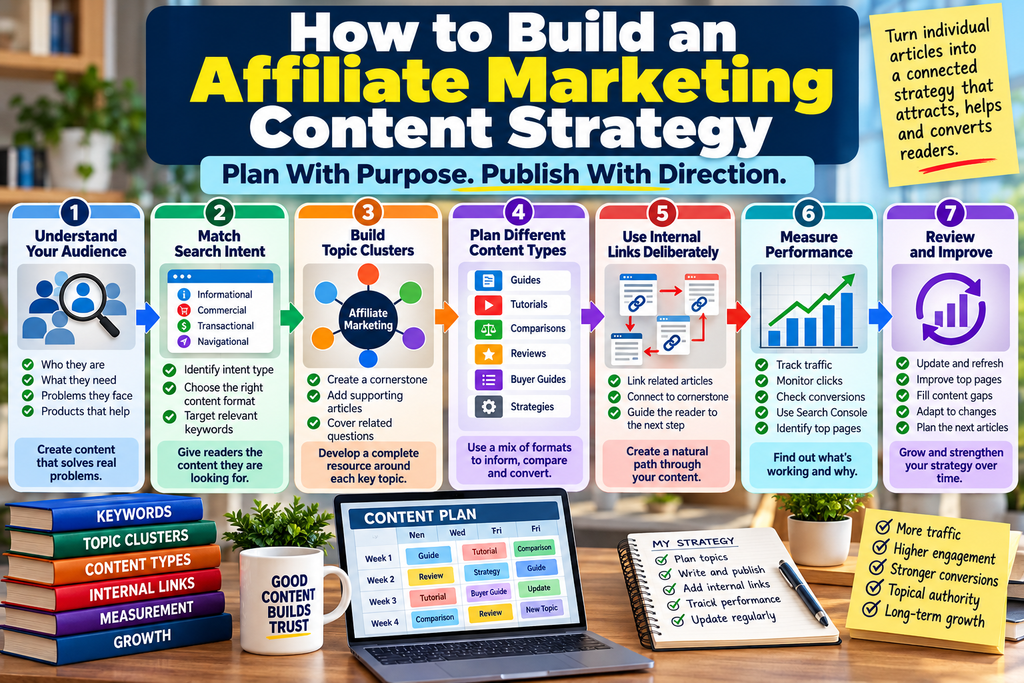
An effective affiliate website needs more than individual articles.
It needs a plan.
Without one, content often becomes a collection of disconnected posts written whenever an idea appears.
That can make it harder to build topical authority, guide readers through related subjects, measure what is working, or create a clear path toward monetisation.
A strong affiliate marketing content strategy brings those pieces together.
It helps you decide:
- what to publish,
- who each article is for,
- how different topics connect,
- which pages have commercial value,
- which pages build trust,
- and what should be published next.
The goal is not simply to create more content.
It is to create the right content in the right sequence.
Start With the Audience, Not the Keywords
Keyword research is useful.
But keywords should not be the starting point.
The starting point is the audience.
Ask:
- Who are they?
- What are they trying to achieve?
- What problems are they facing?
- What decisions are they likely to make?
- What products or services may genuinely help them?
Once those questions are clear, keywords become much easier to interpret.
A search phrase is not just a phrase.
It represents a person looking for something.
Define the Core Problem Your Site Helps Solve
Strong affiliate sites usually have a clear area of focus.
For example:
- helping beginners start email marketing,
- helping small businesses choose automation tools,
- helping creators compare software,
- helping marketers understand affiliate systems.
The clearer the problem, the easier it becomes to decide whether a topic belongs on the site.
A good test is:
Does this article help the same audience solve a related problem?
If yes, it probably strengthens the site.
If not, it may create unnecessary distraction.
Build Around Topic Clusters
A topic cluster is a group of related articles built around one broader subject.
For example, an Affiliate Marketing cluster might include:
- What Is Affiliate Marketing?
- How Affiliate Marketing Actually Works
- How to Choose an Affiliate Offer
- Affiliate Networks vs Independent Affiliate Programs
- Recurring vs One-Time Affiliate Commissions
- Affiliate Marketing Tracking Explained
- Affiliate Marketing Metrics That Actually Matter
- Affiliate Marketing Mistakes Beginners Should Avoid
- How to Promote Affiliate Offers Without Sounding Salesy
- Affiliate Marketing Content That Converts
Each article answers a different question.
Together, they provide a much fuller treatment of the subject.
Choose a Cornerstone Article
A cornerstone article gives the cluster a clear centre.
It should usually cover the broadest version of the topic.
For an Affiliate Marketing cluster, that might be:
What Is Affiliate Marketing? A Practical Beginner’s Guide
The cornerstone article does not need to contain every detail.
Its role is to introduce the subject and point readers toward more specialised articles.
Supporting Articles Should Go Deeper
Supporting articles should answer narrower questions.
For example:
The cornerstone may briefly mention tracking.
A supporting article can explain:
- cookies,
- attribution,
- conversion tracking,
- tracking windows,
- reporting.
The cornerstone introduces the idea.
The supporting article develops it.
That structure helps readers move from broad understanding to specific knowledge.
Match Content to Search Intent
Search intent is one of the most important parts of content planning.
A keyword can suggest what the searcher expects to find.
Common intent types include:
Informational
The reader wants to learn.
Examples:
- what is affiliate marketing,
- how affiliate tracking works,
- what is EPC,
- how recurring commissions work.
Commercial Investigation
The reader is comparing options.
Examples:
- best affiliate networks,
- Product A vs Product B,
- best email tools for beginners.
Transactional
The reader may be close to taking action.
Examples:
- Product X pricing,
- Product X review,
- buy Product X,
- Product X discount.
Navigational
The reader is trying to reach a specific site or resource.
Examples:
- Product X login,
- Product X dashboard,
- Company Y affiliate program.
A good affiliate marketing content strategy should usually include several intent types.
Do Not Build a Site Made Only of Reviews
Reviews can be commercially valuable.
But a site containing nothing but reviews may feel thin and overly promotional.
A stronger mix includes:
- informational guides,
- tutorials,
- comparisons,
- reviews,
- buyer guides,
- alternatives articles,
- problem-solution content.
This gives readers useful reasons to visit even when they are not ready to buy.
Use Informational Content to Build Authority
Informational content helps establish expertise and trust.
Examples include:
- definitions,
- beginner guides,
- strategy articles,
- explainers,
- tutorials.
These pages may not produce the highest immediate affiliate revenue.
But they can:
- attract search traffic,
- introduce new readers,
- support internal linking,
- build topical depth,
- and lead readers toward commercial pages later.
Use Commercial Content Carefully
Commercial content includes:
- reviews,
- comparisons,
- buyer guides,
- alternatives articles.
These pages may have stronger conversion potential.
But they also require more care.
Readers expect:
- balance,
- transparency,
- useful comparisons,
- realistic claims,
- and clear reasoning.
A commercial page should still help the reader even if they do not purchase.
Plan the Reader Journey
A good content strategy should consider what the reader may want next.
For example:
- What is affiliate marketing?
- How does it work?
- How do I choose an offer?
- What type of commission should I prefer?
- How does tracking work?
- Which metrics matter?
- What mistakes should I avoid?
- How should I promote offers?
- What content types convert?
- How should I plan all this?
That sequence is not accidental.
It moves the reader from understanding toward execution.
Publish in a Logical Sequence
Publishing order can strengthen a cluster.
A practical sequence might be:
Stage 1: Foundation
Publish broad educational content.
Examples:
- cornerstone guide,
- how-it-works article,
- basic terminology.
Stage 2: Evaluation
Add content that helps readers compare options.
Examples:
- offer selection,
- commission structures,
- networks vs direct programs.
Stage 3: Execution
Add practical implementation content.
Examples:
- tracking,
- metrics,
- promotion,
- tutorials.
Stage 4: Commercial Content
Add:
- reviews,
- comparisons,
- buyer guides.
This creates a more natural site structure.
Use Internal Links Deliberately
Internal linking should not be random.
Each link should help the reader.
Useful reasons to link include:
- explaining a related concept,
- providing more detail,
- answering the next question,
- supporting a claim,
- directing the reader toward a useful comparison.
A good internal link feels like part of the article.
It should not feel inserted merely for SEO.
Link Broad Pages to Specific Pages
Cornerstone pages should usually link to supporting content.
Supporting pages should also link back to the cornerstone.
This creates a two-way relationship.
For example:
What Is Affiliate Marketing?
may link to:
Affiliate Marketing Tracking Explained
The tracking article may link back to the beginner guide.
This helps readers move through the cluster naturally.
Link Supporting Articles to Each Other
Supporting articles should also connect when relevant.
For example:
A tracking article may link to a metrics article.
A metrics article may link to an offer-selection article.
A promotion article may link to a content-format article.
This creates a useful web of related information.
Avoid Overlinking
Too many internal links can become distracting.
The goal is not to link every possible phrase.
Link where it genuinely helps the reader.
A few strong contextual links are often better than dozens of weak ones.
Build Around Questions
Questions are excellent content-planning tools.
For every core topic, ask:
- What is it?
- How does it work?
- Why does it matter?
- How do I do it?
- What mistakes should I avoid?
- What tools help?
- What are the alternatives?
- How do I choose?
- How do I measure success?
Each question may become a useful article.
Use Search Suggestions for Topic Discovery
Search engines can reveal what people are asking.
Useful sources include:
- autocomplete,
- related searches,
- People Also Ask,
- Search Console queries,
- forum discussions,
- community questions,
- product support pages.
The goal is not to copy every suggestion.
It is to identify recurring questions that fit the site.
Use Competitor Research Carefully
Competitor research can show:
- which topics are common,
- what content formats perform well,
- which questions are being answered,
- where gaps may exist.
But the goal should not be to reproduce competitor content.
Look for ways to improve it.
Ask:
- What is missing?
- What is outdated?
- What is unclear?
- What could be explained more simply?
- What could be more practical?
That is where differentiation comes from.
Look for Content Gaps
A content gap is a useful topic the site does not yet cover.
For example:
If a cluster explains affiliate tracking but never explains attribution models, that may be a gap.
If it explains commissions but not payment thresholds, that may be another.
Content gaps help identify logical next articles.
Prioritise Topics by Value
Not every keyword deserves immediate attention.
A simple prioritisation model can consider:
- relevance,
- search intent,
- competition,
- commercial value,
- internal-link value,
- audience usefulness.
A topic may have low search volume and still be valuable if it supports several important pages.
Do Not Chase Search Volume Alone
High-volume keywords are attractive.
But they may also be:
- highly competitive,
- too broad,
- poorly matched to the audience,
- or weak commercially.
Lower-volume topics may convert better if they match stronger intent.
Search volume is one factor.
It should not control the entire strategy.
Balance Evergreen and Timely Content
Evergreen content remains useful for a long time.
Examples:
- how affiliate marketing works,
- how to choose an offer,
- how tracking works.
Timely content may cover:
- product updates,
- platform changes,
- new tools,
- industry developments.
A strong strategy can use both.
Evergreen content creates stability.
Timely content can capture current interest.
Create Content With Updating in Mind
Some articles need more maintenance than others.
Reviews and buyer guides may need frequent updates.
Evergreen educational articles may change less often.
When planning content, consider:
- how often pricing changes,
- how often product features change,
- whether screenshots will age,
- whether links may break,
- whether program terms may change.
Maintenance is part of the strategy.
Build a Simple Editorial Calendar
An editorial calendar does not need to be complicated.
It may include:
- article title,
- focus keyword,
- category,
- intent,
- status,
- target publication date,
- internal links,
- update date.
The purpose is visibility.
You should know what is planned, what is in progress, and what has been published.
Group Articles Into Batches
Batch planning can make publishing easier.
For example:
Instead of thinking about one article at a time, plan five related articles.
This helps with:
- research,
- internal linking,
- consistent terminology,
- faster publishing,
- better cluster structure.
The articles can still be written individually.
The planning happens as a group.
Reuse Research Across Related Articles
Research for one article may help several others.
For example, research into affiliate networks may support:
- a comparison article,
- a beginner guide,
- a tracking article,
- a commission article.
This makes the content process more efficient.
Avoid Repeating the Same Article
Related does not mean duplicate.
Two articles can cover the same broad topic but must have different purposes.
For example:
and
Affiliate Marketing Tracking Explained
are related.
But one explains the overall process.
The other focuses specifically on tracking.
Each article should have a clear reason to exist.
Define the Purpose Before Writing
Before creating an article, answer:
- What question does this article answer?
- Who is it for?
- What should the reader understand by the end?
- What should they read next?
- Is there a natural affiliate opportunity?
This prevents unfocused writing.
Decide Whether the Article Should Monetise Directly
Not every article needs affiliate links.
A useful content strategy can include:
Directly Monetised Pages
Examples:
- reviews,
- comparisons,
- buyer guides.
Indirectly Monetised Pages
Examples:
- tutorials,
- informational guides,
- strategy articles.
Indirect pages may send readers toward commercial pages later.
Both have value.
Build Trust Before Monetisation
Trust improves the effectiveness of affiliate content.
A site should demonstrate:
- useful information,
- clear disclosures,
- balanced recommendations,
- consistent editorial standards,
- reliable navigation,
- working contact information.
Commercial success usually becomes easier when trust already exists.
Measure Content by Purpose
Not every article should be judged by the same metric.
An informational guide may succeed by generating:
- traffic,
- engagement,
- internal clicks.
A comparison article may be judged by:
- affiliate clicks,
- conversions,
- revenue per visitor.
A tutorial may produce:
- engagement,
- email sign-ups,
- assisted conversions.
Context matters.
Track the Metrics That Matter
Useful affiliate metrics include:
- clicks,
- click-through rate,
- conversion rate,
- earnings per click,
- revenue per page,
- reversal rate,
- recurring revenue,
- retention.
Our guide to Affiliate Marketing Metrics That Actually Matter explains these in more detail.
Use Search Console Data
Once a site begins appearing in search results, Search Console can reveal:
- queries,
- impressions,
- clicks,
- average positions,
- indexed pages.
This can help identify:
- topics gaining traction,
- pages with impressions but few clicks,
- new keyword opportunities,
- pages that may need updating.
Search Console becomes more useful as the site gains data.
Use Performance Data to Guide Updates
Publishing is not the final step.
After enough data exists, ask:
- Which pages get impressions?
- Which pages get clicks?
- Which pages convert?
- Which pages send readers elsewhere?
- Which pages have declined?
Updates can sometimes produce more value than publishing something new.
Improve Strong Pages First
If a page is already attracting traffic, small improvements may have a larger impact.
Possible updates include:
- stronger introductions,
- better internal links,
- clearer headings,
- updated examples,
- improved CTAs,
- refreshed screenshots.
Pages with signs of traction deserve attention.
Do Not Abandon New Content Too Quickly
New articles may take time to:
- be discovered,
- be crawled,
- be indexed,
- gain impressions,
- rank.
Avoid making major changes too quickly.
Give the content enough time to generate useful signals.
Avoid Publishing Randomly
Random publishing can create:
- weak topic coverage,
- poor internal linking,
- conflicting articles,
- unclear site focus.
A planned cluster usually produces a cleaner structure.
Readers can see how the information fits together.
Search engines can also more easily understand the relationships.
Use Reviews and Commercial Content After Building Context
Commercial pages may work better when the site already has supporting information.
For example:
A product review can link to:
- beginner guides,
- tutorials,
- comparisons,
- metrics articles.
That provides context.
It also makes the review feel like part of a broader publication.
Keep the Reader Journey Simple
The reader should not need to understand your content strategy.
Navigation should feel natural.
They should simply find:
- the answer they need,
- related information,
- the next useful step.
Good strategy is often invisible to the reader.
A Simple Content Planning Framework
For every new topic, answer five questions:
1. Who is the reader?
Define the audience.
2. What are they trying to do?
Identify the problem or decision.
3. What stage are they in?
Awareness, consideration, or decision.
4. Which content format fits best?
Guide, tutorial, comparison, review, or buyer guide.
5. What should they read next?
Plan the internal links.
This simple process can prevent many content-planning mistakes.
Example: Building an Affiliate Marketing Cluster
A practical sequence might look like this:
Foundation
- What Is Affiliate Marketing?
- How Affiliate Marketing Actually Works
Evaluation
- How to Choose an Affiliate Offer
- Affiliate Networks vs Independent Affiliate Programs
- Recurring vs One-Time Affiliate Commissions
Measurement
- Affiliate Marketing Tracking Explained
- Affiliate Marketing Metrics That Actually Matter
Execution
- Affiliate Marketing Mistakes Beginners Should Avoid
- How to Promote Affiliate Offers Without Sounding Salesy
- Affiliate Marketing Content That Converts
Strategy
- How to Build an Affiliate Marketing Content Strategy
That sequence creates a logical learning path.
Internal Linking Should Support the Cluster
Once the articles exist, connect them deliberately.
The cornerstone should link outward.
Supporting articles should link back.
Related articles should connect to each other.
The result should feel like a structured resource centre.
Quality Still Matters More Than the Plan
A content strategy does not compensate for weak articles.
The strategy provides direction.
The content still needs:
- clear writing,
- useful information,
- accurate claims,
- thoughtful structure,
- trustworthy recommendations.
Planning and quality have to work together.
Final Thoughts
An affiliate marketing content strategy turns publishing from a series of isolated tasks into a connected system.
It helps you:
- choose better topics,
- match content to search intent,
- create stronger clusters,
- guide readers naturally,
- prioritise commercial opportunities,
- improve internal linking,
- and measure performance more intelligently.
The goal is not to publish everything.
It is to build a useful body of content that makes sense as a whole.
When each article has a clear purpose, a clear audience, and a clear relationship to the rest of the site, the entire publication becomes stronger.
That is the real value of content strategy.