
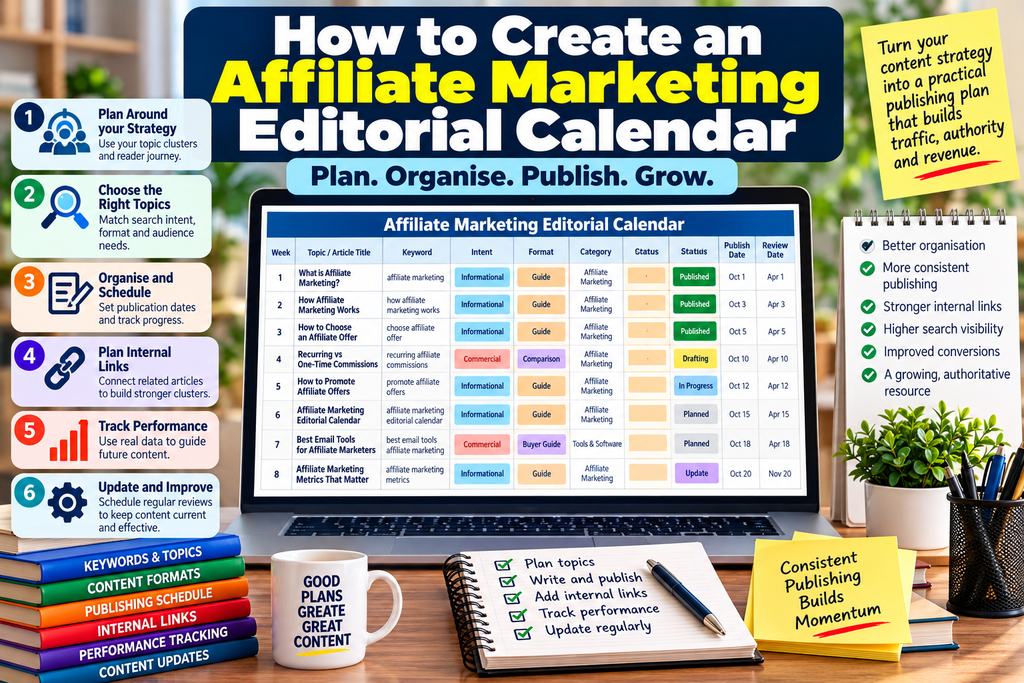
An affiliate website can have a strong strategy and still become difficult to manage if there is no publishing system behind it.
Ideas accumulate.
Drafts get started and forgotten.
Commercial articles receive too much attention while useful educational content gets postponed.
Older pages need updating, but nobody remembers when they were last reviewed.
An affiliate marketing editorial calendar helps solve those problems.
It turns a content strategy into a practical publishing schedule.
Instead of asking, “What should I write today?” each time you sit down to create content, you already know what comes next, why it matters, how it connects to existing articles, and what role it plays in the overall site.
The calendar does not need to be complicated.
It simply needs to help you publish with purpose.
What Is an Affiliate Marketing Editorial Calendar?
An editorial calendar is a planning system for content.
At its simplest, it records what you intend to publish and when.
For affiliate marketers, however, it can do much more.
A useful calendar can track the topic, target keyword, search intent, content format, category, publication status, internal links, monetisation purpose, update schedule, and performance review date.
That makes it more than a diary.
It becomes a working map of the content operation.
Why Affiliate Sites Need More Than a List of Article Ideas
A list of ideas tells you what you could write.
A calendar tells you what you should write next.
That distinction matters.
Suppose you have ideas for:
a beginner guide, three product reviews, two comparisons, a tutorial, and a buyer guide.
If you publish them randomly, the site may feel disjointed.
If you plan them strategically, you might first publish the beginner guide, then supporting educational articles, then the tutorial, followed by comparisons and reviews.
The same articles become more useful because they are released in a logical sequence.
This is one of the ideas developed in How to Build an Affiliate Marketing Content Strategy.
The strategy determines direction.
The editorial calendar turns that direction into action.
Start With Your Main Topic Clusters
The calendar should reflect the structure of the website.
If Affiliate Marketing is one of your main categories, the calendar should show which parts of that cluster are already covered and which still need development.
For example, an Affiliate Marketing cluster might include foundational guides, tracking, metrics, commissions, promotion, content strategy, reviews, tutorials, and buyer guides.
Once you can see the cluster as a whole, planning becomes easier.
You are no longer selecting articles in isolation.
You are strengthening an existing body of content.
Identify the Cornerstone Content First
Each major cluster should normally have one or more broad articles that provide the foundation.
For Affiliate Marketing, a cornerstone article might be What Is Affiliate Marketing? A Practical Beginner’s Guide.
Supporting articles can then explore narrower subjects.
This approach helps the calendar remain balanced.
If the supporting content exists but the foundational article does not, the cluster may feel incomplete.
If the cornerstone exists but there are no deeper supporting articles, the site may lack topical depth.
The calendar helps you see both situations.
Plan Around the Reader Journey
A reader may move through several stages before making a purchase.
They may begin by asking what something is.
Then they want to understand how it works.
Later they compare approaches.
Eventually they evaluate products.
The editorial calendar should reflect that journey.
A sensible sequence might move from education to evaluation, then to execution and commercial decision-making.
That mirrors the structure discussed in Affiliate Marketing Content That Converts, where different formats serve different stages of the buyer journey.
Give Every Article a Purpose
Before an article enters the calendar, decide why it exists.
Some articles are designed to attract new readers.
Others build trust.
Some explain a complicated concept.
Others support commercial decisions.
Some may lead directly to affiliate offers.
Others may never contain an affiliate link at all.
That is perfectly acceptable.
An article should not be judged solely by whether it generates immediate sales.
Its value may be in supporting the rest of the site.
Add Search Intent to the Calendar
Search intent helps determine what kind of article should be created.
A query beginning with “what is” is usually informational.
A search containing “vs” suggests comparison intent.
“Best” may indicate a buyer guide.
“Review” usually signals a reader who is closer to making a decision.
Recording intent in the calendar prevents mismatches between keyword and format.
If the reader wants a comparison, give them a comparison.
If they want a tutorial, do not give them a sales page.
Record the Focus Keyword Before Writing
Choosing the primary keyword before drafting gives the article a clear direction.
It helps with the title, slug, headings, meta description, image ALT text, and overall focus.
This does not mean forcing the keyword repeatedly into the content.
It simply provides a central phrase around which the article is organised.
The keyword should serve the article.
The article should not be distorted to satisfy the keyword.
Decide the Content Format in Advance
The editorial calendar should also identify the intended format.
A subject may work best as a guide, tutorial, comparison, review, buyer guide, case study, checklist, or explanatory article.
Choosing the format early makes writing easier.
It also helps balance the site.
If the calendar contains fifteen reviews and only two educational articles, that imbalance becomes obvious immediately.
Balance Informational and Commercial Content
Affiliate publishers naturally pay attention to articles that can generate commissions.
That makes sense.
But an editorial calendar filled only with reviews and buyer guides can produce a site that feels overly promotional.
Educational articles provide context.
Tutorials demonstrate expertise.
Explanatory content attracts readers earlier in the journey.
Commercial pages then become more credible because they sit inside a broader resource.
The balance does not need to be exact.
It simply needs to feel intentional.
Plan Internal Links Before Publishing
Internal linking should not be an afterthought.
When an article is added to the calendar, consider which existing pages it should link to and which existing pages should eventually link back.
For example, a new article about affiliate tracking might naturally connect with content about how affiliate marketing works and which performance metrics matter.
Planning those connections beforehand saves time during publishing.
It also strengthens the topic cluster.
Use the Calendar to Prevent Orphaned Content
An orphaned article has few or no internal links pointing to it.
That makes it harder for readers to discover and may weaken its relationship with the rest of the site.
A calendar can include a simple internal-link check before publication.
Before an article goes live, ask whether it has appropriate links to related content and whether at least one relevant existing article should be updated to link back to it.
This creates a growing network rather than a pile of isolated pages.
Include the Publication Status
A useful calendar should make it easy to see where every article stands.
Possible statuses might include idea, researched, drafting, editing, ready for image, ready to publish, published, and scheduled for update.
This prevents work from disappearing into unfinished drafts.
It also allows you to resume quickly after interruptions.
That is particularly useful when content work happens in shorter sessions rather than one long uninterrupted block.
Avoid Overloading the Schedule
An editorial calendar should create clarity, not pressure.
Publishing more frequently is not automatically better.
The appropriate schedule depends on:
content quality, research requirements, available time, site maturity, and how much updating existing content requires.
A realistic schedule that you can sustain is better than an ambitious schedule that collapses after two weeks.
Consistency matters more than speed.
Leave Room for Unexpected Topics
A calendar should provide structure without becoming rigid.
New opportunities will appear.
A product may launch.
A platform may change its pricing.
A major industry development may create a useful article opportunity.
Leave some flexibility.
If every publishing slot is committed months in advance, it becomes difficult to respond to relevant developments.
Separate Evergreen and Timely Content
Evergreen content is designed to remain useful for long periods.
Examples include how affiliate marketing works, how to choose an offer, and how to interpret affiliate metrics.
Timely content may cover product changes, industry developments, platform updates, or new tools.
Your calendar can contain both.
Evergreen articles provide the foundation.
Timely articles help the publication stay current.
Schedule Content Updates Too
An editorial calendar should not only plan new articles.
It should also plan maintenance.
Reviews can become outdated.
Pricing changes.
Screenshots age.
Affiliate programs alter terms.
External links break.
Statistics become stale.
An older article that already has visibility may sometimes deserve attention before another new article is published.
Treat updates as real editorial work.
Add a Review Date to Important Articles
Commercial articles should usually have a future review date.
A review or buyer guide may need checking more frequently than a broad educational article.
The calendar can record when each article should be revisited.
This does not mean rewriting it on a fixed schedule regardless of need.
It simply creates a reminder to check whether anything important has changed.
Prioritise Articles by Strategic Value
Not every idea deserves the same urgency.
An article may deserve higher priority if it fills a major topic gap, strengthens an important cluster, supports several existing pages, addresses strong commercial intent, or answers a recurring reader question.
This is often more useful than prioritising only by search volume.
A low-volume article can still have high strategic value.
Use Commercial Value Without Letting It Take Over
Affiliate sites need revenue.
So commercial potential belongs in the planning process.
But it should be one factor rather than the only one.
A strong calendar balances audience usefulness with business value.
That balance is also central to learning how to promote affiliate offers without sounding salesy, because useful content should lead the commercial message rather than the other way around.
That can include educational articles that build traffic and trust alongside reviews, comparisons, and buyer guides that support monetisation.
Plan Article Sequences
Some articles work particularly well when published in sequence.
For example, a cluster might move through:
understanding affiliate marketing, learning how it works, choosing an offer, understanding commission structures, learning tracking, analysing metrics, avoiding mistakes, promoting offers, creating content, and developing a strategy.
Each article prepares the reader for the next.
An editorial calendar makes these sequences visible before publication begins.
Batch Related Topics
Planning several related articles together can improve consistency.
Research conducted for one article may support another.
Terminology remains consistent.
Internal linking becomes easier.
Graphics can follow a coherent visual direction.
The articles can still be written one at a time.
The advantage comes from planning them as a connected group.
Keep the Calendar Simple Enough to Use
The best editorial calendar is the one you actually maintain.
It does not require specialised software.
A spreadsheet can work.
A project-management tool can work.
Even a simple document can work for a small site.
The important thing is that you can quickly see what is planned, what is being worked on, what has been published, and what needs attention.
Complexity is not the objective.
Visibility is.
What to Track in the Calendar
A practical affiliate editorial calendar might contain the article title, focus keyword, category, search intent, format, status, planned publication date, internal-link targets, monetisation role, live URL, and future review date.
You may also add performance data later.
The calendar can evolve as the site grows.
There is no need to build every field on day one.
Use Search Console to Improve Future Planning
After content has been indexed and begins receiving impressions, Google Search Console can provide useful planning information.
It may reveal search queries you had not considered.
A page may begin appearing for a related topic that deserves its own article.
Another page may receive impressions but few clicks.
That information can feed back into the calendar.
The publishing plan becomes partly driven by real audience behaviour rather than assumptions alone.
Let Performance Influence the Calendar
Over time, the calendar can become more intelligent.
If tutorials consistently attract useful traffic, plan more tutorials.
If comparison articles generate strong conversions, consider related comparisons.
If a particular cluster is gaining visibility, strengthen it with additional supporting content.
This connects directly with Affiliate Marketing Metrics That Actually Matter.
Measurement should influence future publishing decisions.
Do Not React to Every Short-Term Change
Performance data needs time.
A new article may not show meaningful search activity immediately.
Avoid constantly rearranging the calendar based on a few days of results.
Look for patterns.
Publishing strategy should respond to evidence, not noise.
Include Content Refreshes in Quiet Periods
Not every publishing period needs a brand-new article.
A lighter week can be used to:
improve internal links, update older articles, refresh screenshots, improve introductions, verify affiliate links, review meta descriptions, or strengthen calls to action.
This keeps the existing library healthy.
Editorial Calendars Support Quality Control
The calendar can also include checkpoints before publication.
An article might move through writing, internal linking, SEO review, image creation, preview, publication, and device testing.
This creates consistency.
The reader does not see the workflow.
They simply see a publication that appears organised and dependable.
Use the Calendar to Maintain Editorial Standards
Consistency matters beyond SEO.
The calendar can help ensure every article receives the same editorial treatment.
That might include checking disclosures, verifying claims, reviewing recommendations, confirming mobile display, and ensuring the article fits the publication’s editorial policies.
For affiliate content, trust is especially important.
Avoid Turning the Calendar Into a Production Quota
An editorial calendar is a planning tool.
It should not force weak content into publication merely because a date has arrived.
If an article needs another day of research, give it another day.
If the subject no longer seems useful, remove it.
The calendar exists to improve publishing decisions.
Publishing exists to serve readers.
A Practical Monthly Rhythm
A smaller affiliate publication might choose a simple rhythm in which one week focuses on educational content, another on a tutorial or implementation article, another on commercial evaluation content, and another on updating existing pages or filling a topic gap.
That rhythm can be adjusted as the site grows.
The important thing is maintaining a healthy mix.
Connect the Calendar to Your Content Strategy
The editorial calendar and content strategy perform different jobs.
The strategy answers:
Where are we going?
The calendar answers:
What are we doing next?
The strategy identifies clusters, audiences, intent, commercial priorities, and content formats.
The calendar schedules the work required to build them.
Together, they turn content creation into a repeatable system.
Example: Expanding an Affiliate Marketing Cluster
Suppose the core educational articles are already published.
The editorial calendar might identify the next gaps as:
product research, affiliate disclosures, review methodology, conversion optimisation, email list building, traffic generation, and specific buyer guides.
Those topics can then be ordered according to usefulness and strategic value.
This prevents random expansion.
Each new article has a reason for being next.
Review the Calendar Regularly
The calendar should be reviewed periodically.
Ask whether the planned topics still make sense.
Some may become more important.
Others may become unnecessary.
New gaps may appear.
Published articles may need updating.
The plan should evolve with the website.
Final Thoughts
An affiliate marketing editorial calendar is not simply a list of dates.
It is the operational side of content strategy.
It helps turn ideas into an organised publishing system.
A good calendar helps you choose the right topics, maintain a balanced mix of content, plan internal links, protect quality, schedule updates, and make publishing decisions based on evidence rather than impulse.
Most importantly, it removes one of the biggest sources of wasted time:
wondering what to do next.
When the plan is clear, content creation becomes easier to manage.
And when each article supports a larger strategy, the site becomes stronger with every publication.