
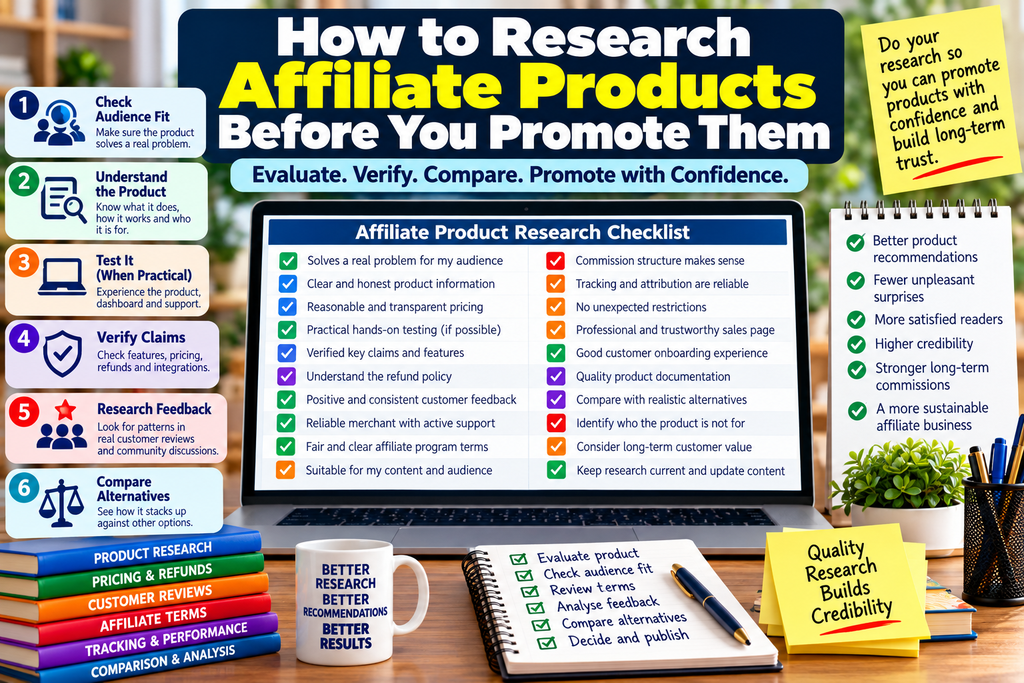
Choosing an affiliate product should involve more than looking at the commission.
A generous payout can attract attention, but it tells you very little about whether the product is genuinely useful, whether customers are satisfied, whether the merchant pays reliably, or whether the offer is suitable for your audience.
That is why learning how to research affiliate products before promoting them is an important part of responsible affiliate marketing.
Good research helps you answer a simple question:
Is this something I am comfortable putting my reputation behind?
That matters because every affiliate recommendation affects more than a single commission.
It affects trust.
Why Product Research Matters
Affiliate marketers operate between the merchant and the customer.
You may not create the product.
You may not control the checkout process, fulfilment, customer support, refund policy, or future pricing.
But when you recommend the product, your audience may associate their experience with you.
If the product disappoints them, the merchant may lose a customer.
You may lose trust.
That makes product research part of the editorial process, not merely a commercial decision.
Start With Audience Fit
Before examining commission rates or promotional materials, ask whether the product makes sense for your audience.
A strong offer should solve a problem that your readers genuinely have.
Consider:
- Who is the product designed for?
- What problem does it solve?
- How important is that problem?
- Does it fit the reader’s level of experience?
- Is the price realistic for the intended audience?
- Are there simpler or better alternatives?
A technically excellent product can still be a poor affiliate offer if it does not match the people reading your content.
This is one of the principles explored more deeply in How to Choose an Affiliate Offer.
Understand Exactly What the Product Does
Do not promote something you cannot explain clearly.
Before recommending a product, you should be able to describe:
- what it does,
- how it works,
- what the customer receives,
- how it differs from alternatives,
- and what problem it is intended to solve.
If the product’s own website leaves you confused, that may itself be useful information.
A prospective customer may experience the same confusion.
Use the Product Yourself When Practical
First-hand experience is one of the strongest forms of product research.
When practical, test:
- the signup process,
- dashboard,
- major features,
- onboarding,
- documentation,
- support,
- cancellation process,
- and overall usability.
You do not need to become an expert in every feature.
But using the product can reveal things that promotional pages do not.
You may discover that setup is easier than expected.
Or harder.
A feature described prominently on the sales page may turn out to be available only on a higher-priced plan.
These details improve the quality of your recommendation.
What If You Cannot Test the Product?
Not every product can realistically be purchased or tested.
Some may be expensive.
Others may require specialised equipment, business accounts, or lengthy subscriptions.
In those cases, make the distinction clear.
Research the product through reliable sources, but do not imply personal experience you do not have.
You can still examine:
- official documentation,
- demonstrations,
- help centres,
- pricing pages,
- user feedback,
- independent reviews,
- and available trial accounts.
Transparency is more valuable than pretending to know more than you do.
Study the Product Website Carefully
The merchant’s website is the logical starting point.
Look beyond the headline.
Examine:
- features,
- pricing,
- plan limitations,
- refund terms,
- cancellation procedures,
- support options,
- integrations,
- documentation,
- company information.
You are trying to understand the complete customer proposition.
Pay particular attention to what is not explained clearly.
Missing information may indicate an area that deserves further research.
Separate Features From Benefits
A feature tells you what the product includes.
A benefit explains why that feature matters.
For example:
Feature: automated email sequences.
Benefit: follow-up messages can be sent without manually emailing every subscriber.
Understanding that distinction makes your eventual affiliate content more useful.
Rather than repeating the merchant’s feature list, you can explain what those features mean in practical terms.
Verify Important Claims
Marketing pages naturally emphasise strengths.
That does not mean every claim is false.
But significant claims should be checked where possible.
If a company states that a tool integrates with a particular platform, confirm the integration.
If a pricing page promises unlimited usage, look for qualification or fair-use restrictions.
If a product claims a specific capability, check documentation or demonstrations.
Affiliate content becomes more credible when claims are verified rather than repeated.
Check the Pricing Structure
Price is more complicated than the headline figure.
Look for:
- monthly versus annual pricing,
- introductory prices,
- renewal rates,
- usage limits,
- required upgrades,
- transaction fees,
- add-ons,
- cancellation requirements.
A product advertised at a low starting price may become significantly more expensive as usage grows.
That does not automatically make it a poor product.
But the reader deserves context.
Examine the Refund Policy
Refund policies can reveal a great deal about an offer.
Determine:
- whether refunds are available,
- how long the refund window lasts,
- what conditions apply,
- whether some purchases are excluded,
- and how customers request refunds.
The refund policy also matters to you as an affiliate because refunds may lead to reversed commissions.
This connects directly with the performance issues discussed in Affiliate Marketing Metrics That Actually Matter.
Research Customer Feedback
Customer reviews can reveal recurring strengths and weaknesses.
Do not rely on one dramatic review.
Look for patterns.
Repeated comments about:
- poor support,
- unexpected billing,
- difficult cancellation,
- bugs,
- slow delivery,
- or misleading advertising
deserve attention.
The same applies to recurring praise.
If many users independently mention ease of use or strong support, that may strengthen confidence.
Treat Reviews as Evidence, Not Absolute Truth
Online reviews require judgment.
Some may be outdated.
Some may reflect unusual circumstances.
Some may be written by competitors or enthusiastic affiliates.
Others may refer to older versions of the product.
Use reviews as one source among several.
The goal is to identify recurring themes rather than treating every comment as verified fact.
Check Independent Communities
Community discussions can sometimes reveal issues that polished review sites overlook.
Depending on the product, useful sources may include:
- specialist forums,
- Reddit discussions,
- Facebook groups,
- user communities,
- professional groups.
Look for questions people repeatedly ask.
These can identify:
- common frustrations,
- confusing features,
- useful capabilities,
- and reasons people switch to competitors.
These insights may also generate future content ideas.
Investigate the Merchant
A good product can become a poor affiliate opportunity if the company behind it is unreliable.
Research the merchant itself.
Look at:
- how long it has operated,
- company transparency,
- customer-support reputation,
- product history,
- major complaints,
- communication quality,
- and whether the company appears actively maintained.
You are not trying to prove that a business is perfect.
You are trying to determine whether there are obvious reasons for caution.
Look for Signs of Stability
Affiliate marketing often works better with merchants that demonstrate reasonable stability.
Possible positive signs include:
- regularly updated products,
- active documentation,
- responsive support,
- maintained websites,
- clear pricing,
- transparent program terms,
- consistent communication.
Conversely, abandoned help pages or unanswered support channels may deserve scrutiny.
Examine the Affiliate Program Separately
Do not assume that a good product automatically has a good affiliate program.
Evaluate the program independently.
Look at:
- commission rate,
- recurring versus one-time payments,
- payment schedule,
- minimum payout,
- cookie or tracking period,
- attribution rules,
- permitted traffic sources,
- refund reversals,
- promotional restrictions.
These elements affect whether the opportunity is commercially practical.
Understand the Commission Structure
Commission percentage alone can be misleading.
A 50% commission on a low-priced product may produce less revenue than a 20% commission on a higher-value product.
Likewise, a recurring commission may become valuable only if customers remain subscribed.
Our guide to Recurring vs One-Time Affiliate Commissions explains why commission structure should be considered alongside retention, customer value, and merchant stability.
Understand the Tracking
You should know how referrals are credited.
Check:
- cookie duration,
- attribution model,
- cross-device limitations,
- tracking links,
- coupon attribution,
- reporting delay,
- and conversion reporting.
Our guide to Affiliate Marketing Tracking Explained explains how these mechanisms connect clicks with commissions.
Poor tracking can make an otherwise attractive program frustrating to promote.
Networks May Provide Additional Information
If the offer operates through an affiliate network, you may have access to useful indicators such as:
- conversion statistics,
- EPC,
- reversal information,
- merchant history,
- promotional resources.
Independent programs may provide different information or more direct communication with the merchant.
The article Affiliate Networks vs Independent Affiliate Programs explains the practical differences between these two structures.
Read the Affiliate Terms
This step is easy to overlook.
Affiliate agreements may restrict:
- paid search,
- brand bidding,
- email promotions,
- social advertising,
- coupon sites,
- domain names,
- trademarks,
- geographic targeting,
- incentive traffic.
Never assume a promotional method is allowed simply because other affiliates appear to use it.
Program terms govern your participation.
Evaluate the Sales Page
Once someone clicks your affiliate link, the merchant’s sales page becomes part of the customer journey.
Examine it as though you were the buyer.
Ask:
- Is the offer clear?
- Does the page explain the product?
- Are claims reasonable?
- Is pricing transparent?
- Is the checkout professional?
- Is the refund policy accessible?
- Does the page create trust?
Your content may generate the click, but the merchant still has to convert the visitor.
Understanding how affiliate marketing actually works also helps you evaluate the entire path from referral and tracking through conversion and commission.
Watch for Excessive Hype
Aggressive marketing does not automatically mean a product is bad.
But excessive claims deserve additional scrutiny.
Examples include:
- guaranteed income,
- effortless results,
- unrealistic timeframes,
- extreme earnings claims,
- vague promises without explanation.
If you would be uncomfortable repeating the claim yourself, investigate it carefully before recommending the offer.
Look at the Customer Journey After Purchase
Product quality includes what happens after checkout.
Where possible, investigate:
- onboarding,
- product delivery,
- account activation,
- tutorials,
- support access,
- billing management,
- cancellation.
A strong purchase experience supports long-term customer satisfaction.
A confusing one may increase refund or cancellation rates.
Customer Support Matters
Support becomes especially important for software, subscriptions, hosting, education, and technical products.
Look for:
- email support,
- live chat,
- help centres,
- response times,
- community assistance,
- documentation.
Customers often judge the product partly by what happens when something goes wrong.
Compare the Product With Alternatives
Research rarely makes sense in isolation.
Compare the product with at least a few realistic alternatives.
Look at:
- price,
- features,
- ease of use,
- support,
- integrations,
- target audience,
- limitations.
The objective is not always to prove that your affiliate offer is best.
It may be best for a particular type of customer.
That distinction produces more credible recommendations.
Identify Who Should Not Buy It
One of the strongest product-research questions is:
Who is this not for?
Perhaps the product is:
- too advanced for beginners,
- too expensive for casual users,
- too limited for larger businesses,
- unnecessary for someone needing only one feature.
Knowing this helps you write balanced content.
It also reduces the temptation to recommend the product to everybody.
Consider Long-Term Customer Value
Some products solve a one-time problem.
Others become part of the customer’s regular workflow.
Products that continue delivering value may produce:
- better retention,
- fewer cancellations,
- stronger recurring commissions,
- and more satisfied customers.
Recurring revenue only works when customers continue seeing value.
Examine Refunds and Reversals
A high advertised commission can look impressive until reversals are taken into account.
If available, examine:
- refund rates,
- cancellation rates,
- reversal rates,
- approval rates.
Net earnings matter more than gross commissions.
This is one reason performance analysis should continue after promotion begins.
Research Before Writing the Review
Do not write the review first and research afterward.
Research should shape the review.
It may change:
- your conclusion,
- intended audience,
- list of advantages,
- list of limitations,
- recommended alternatives.
A useful review is an outcome of investigation, not merely an opportunity to place an affiliate link.
Keep Notes as You Research
Product research becomes easier when observations are recorded systematically.
A simple research sheet might contain:
Product:
Target user:
Problem solved:
Price:
Main strengths:
Main limitations:
Support:
Refund policy:
Affiliate commission:
Tracking period:
Program restrictions:
Alternatives:
Overall assessment:
This creates a repeatable process.
Use Your Editorial Calendar
Product research should also fit the larger publishing plan.
If a product is worth covering, decide whether the best content format is:
- review,
- tutorial,
- comparison,
- buyer guide,
- alternatives article.
Your affiliate marketing editorial calendar can then record the research status, intended format, internal links, and planned publication date.
That prevents commercial articles from appearing randomly.
Match the Research to the Content Type
Different articles require different levels of product research.
A brief mention inside a tutorial may need less evaluation than a dedicated review.
A buyer guide comparing ten products requires broader research.
A head-to-head comparison requires detailed knowledge of both options.
The stronger the recommendation, the stronger the evidence should be.
Research Helps You Avoid Common Mistakes
Poor product research contributes to many affiliate marketing mistakes.
These include:
- choosing offers only for commission,
- promoting low-quality products,
- ignoring refunds,
- misunderstanding tracking,
- overlooking program terms.
Research reduces those risks before the promotion begins.
Research Also Makes Promotion Less Salesy
When you understand the product properly, you do not need exaggerated language.
You can explain:
- where it works well,
- where it does not,
- who should consider it,
- and why.
That naturally supports the approach described in How to Promote Affiliate Offers Without Sounding Salesy.
Useful detail replaces hype.
Keep Research Current
Research has a shelf life.
Products evolve.
Pricing changes.
Features disappear.
Affiliate terms change.
Companies are acquired.
A recommendation that was accurate twelve months ago may no longer be accurate today.
Important commercial content should therefore be reviewed periodically.
Update Existing Content When the Product Changes
If a significant product change occurs, update the relevant article.
Examples include:
- major pricing changes,
- new plans,
- discontinued features,
- altered commission terms,
- changes to the refund policy,
- changes in ownership.
Your editorial calendar can include review dates for this purpose.
Do Not Ignore Negative Findings
Sometimes research leads to the conclusion that an offer should not be promoted.
That is a successful research outcome.
Walking away from a questionable commission can protect the credibility of the publication.
Not every affiliate program deserves a place on your website.
Build a Repeatable Product-Research Process
A practical sequence might look like this:
1. Check audience fit.
Does the product solve a relevant problem?
2. Understand the product.
Know what it does and who it serves.
3. Test it where practical.
Experience the customer journey.
4. Verify claims.
Check important features and promises.
5. Examine pricing and refunds.
Understand the real cost and risk.
6. Research customer feedback.
Look for recurring patterns.
7. Investigate the merchant.
Assess reliability and support.
8. Review affiliate terms.
Understand commissions, tracking, and restrictions.
9. Compare alternatives.
Determine where the product genuinely fits.
10. Decide whether you would recommend it.
That final decision should come after the research, not before it.
A Simple Final Test
Before promoting an affiliate product, ask yourself:
Would I still be comfortable recommending this if the commission were smaller?
The answer does not have to be emotionally perfect.
Affiliate marketing is a business.
The commission matters.
But if compensation is the only reason the product appears attractive, further research may be needed.
Final Thoughts
Learning how to research affiliate products is one of the most valuable disciplines an affiliate publisher can develop.
Good research helps you choose better offers, write stronger content, make more balanced recommendations, reduce unpleasant surprises, and protect audience trust.
The process does not require perfection.
You will never know everything about every product.
But you should know enough to explain why you are recommending it and where its limitations lie.
That shifts affiliate marketing away from simply promoting whatever pays.
It turns the recommendation into an informed editorial decision.
And over time, those decisions help build something more valuable than an individual commission:
credibility.
Pingback: How to Evaluate an Affiliate Program Before Joining