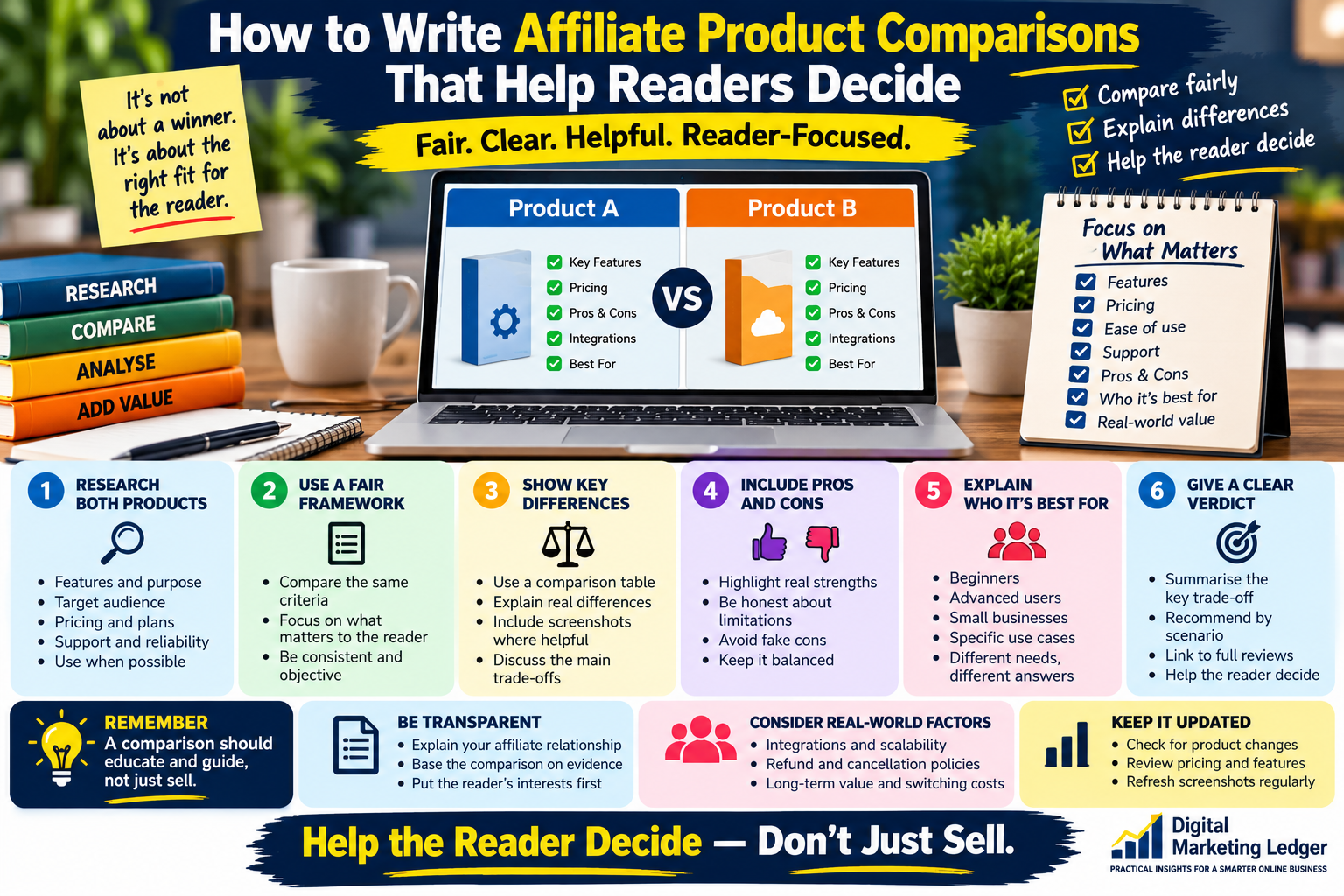
Affiliate product comparisons can be some of the most useful commercial content on a website.
They can also become some of the least trustworthy when the conclusion appears decided before the comparison begins.
A useful affiliate product comparison should not exist merely to declare a winner.
Its real purpose is to help the reader understand:
- how the products differ,
- what each one does well,
- where each one falls short,
- who each product suits,
- and which option makes the most sense for their situation.
That requires a fair comparison framework.
The goal is clarity.
Not competition for its own sake.
If you are still learning the underlying business model, our guide to what is affiliate marketing explains how content, referrals, merchants, tracking, and commissions work together.
Why Product Comparisons Matter
A reader searching for:
Product A vs Product B
is usually further along the buying journey than someone searching for a basic definition.
They already know the products exist.
They may even understand what both products do.
Their problem is now narrower:
Which one should I choose?
That gives comparison content strong commercial intent.
But it also creates responsibility.
If the comparison is shallow or biased, it can push the reader toward the wrong product.
Start With Research on Both Products
Do not research one product thoroughly and treat the other as an afterthought.
The comparison should be based on comparable evidence.
For each product, research:
- purpose,
- audience,
- features,
- pricing,
- support,
- integrations,
- limitations,
- merchant quality.
Our guide to How to Research Affiliate Products Before You Promote Them provides a practical research framework.
The stronger the research, the more useful the comparison.
Use the Products When Practical
First-hand experience can add depth.
Where practical, test both products.
Compare:
- signup,
- setup,
- dashboards,
- important features,
- onboarding,
- documentation,
- support.
Try to evaluate similar tasks in both products.
That makes the comparison more balanced.
Do Not Pretend to Have Tested Something You Have Not
If you have direct experience with one product but not the other, disclose that difference.
You can still write a useful comparison using:
- official documentation,
- demos,
- help centres,
- customer feedback,
- public pricing information.
Transparency is stronger than implied experience.
Define the Reader First
Before comparing features, decide who the article is helping.
For example:
- beginners,
- solo marketers,
- agencies,
- small businesses,
- ecommerce sellers,
- advanced users.
The “better” product often depends on the user.
That is why audience definition should come before the verdict.
Explain the Main Difference Early
Readers should quickly understand why the products are being compared.
For example:
“Both tools provide email marketing and automation, but Product A focuses on simplicity while Product B offers more advanced workflow control.”
That immediately frames the decision.
Avoid the Universal-Winner Trap
One of the weakest comparison formats is:
Product A wins 7 categories. Product B wins 3. Therefore Product A is best.
Buying decisions are rarely that simple.
A product may lose more categories overall but still be better for a specific reader.
For example:
Product A may be better for beginners.
Product B may be better for larger businesses.
That is more useful than forcing one universal winner.
Compare the Same Criteria
A fair comparison uses consistent criteria.
Depending on the products, these may include:
- ease of use,
- features,
- pricing,
- automation,
- integrations,
- support,
- reporting,
- scalability,
- value.
Do not praise one product for an advantage that you never evaluate in the other.
Consistency creates fairness.
Choose Criteria That Matter to the Reader
Not every product feature deserves equal attention.
If the reader is choosing email software, they may care strongly about:
- subscriber limits,
- automation,
- deliverability,
- forms,
- integrations.
A decorative design feature may matter much less.
Prioritize the decision factors.
Use a Quick Comparison Table
A table helps readers scan important differences.
For example:
| Criterion | Product A | Product B |
|---|---|---|
| Ease of use | Beginner friendly | Moderate learning curve |
| Automation | Basic | Advanced |
| Pricing | Lower starting price | Higher starting price |
| Integrations | Good | Extensive |
| Best for | Beginners | Advanced users |
The table should summarize.
It should not replace explanation.
Compare Ease of Use
Ease of use can matter enormously.
Compare:
- setup,
- dashboard,
- navigation,
- workflow,
- learning curve.
Explain why one product may feel easier.
Do not simply give a score.
Compare Core Features
Focus on comparable functions.
If both products offer automation, compare automation.
If both provide landing pages, compare landing pages.
If only one offers a certain feature, explain whether that difference matters to the reader.
Compare Depth, Not Just Availability
Two products may both advertise the same feature.
But implementation may differ significantly.
For example:
Both may offer automation.
One may provide only basic sequences.
The other may provide branching logic, conditions, and advanced triggers.
That difference matters more than a simple “Yes/Yes” feature table.
Compare Pricing Fairly
Pricing comparisons can easily become misleading.
Compare:
- entry price,
- included features,
- usage limits,
- subscriber limits,
- annual discounts,
- upgrade requirements,
- add-ons.
A cheaper starting price may become more expensive later.
Context matters.
Compare Like-for-Like Plans
Avoid comparing the cheapest plan from Product A with the premium plan from Product B unless that reflects a real feature difference.
Try to compare plans serving similar users.
If the structures are too different, explain that.
Compare Value, Not Just Price
The lowest price is not always the best value.
Ask:
- Which product includes more useful features?
- Which one may replace additional tools?
- Which one scales more affordably?
- Which one better fits the reader’s needs?
Price is one dimension of value.
Compare Free Plans and Trials
Free access can affect the decision.
Check whether each product offers:
- free plan,
- free trial,
- demo,
- refund period.
Also compare the limitations.
A free plan may be useful or so restricted that it offers little practical value.
Compare Integrations
For software products, integrations can be decisive.
Compare connections with:
- WordPress,
- payment processors,
- CRMs,
- analytics,
- automation tools,
- ecommerce platforms.
One missing integration can matter more than several minor feature differences.
Compare Support
Evaluate:
- email support,
- live chat,
- onboarding,
- documentation,
- community support.
Support becomes more important as products become more complex.
Compare Documentation
Good documentation can reduce frustration.
Look at:
- setup guides,
- videos,
- knowledge bases,
- tutorials,
- troubleshooting.
A technically powerful product with weak documentation may be difficult for beginners.
Compare Performance and Reliability
Where meaningful, compare:
- uptime,
- speed,
- stability,
- product maintenance,
- major user complaints.
Do not overstate conclusions from isolated reports.
Look for patterns.
Compare Customer Feedback
Customer comments can reveal recurring strengths and weaknesses.
Look for themes around:
- support,
- billing,
- ease of use,
- bugs,
- reliability,
- cancellation.
Use feedback as supporting evidence, not absolute truth.
Compare Refund and Cancellation Policies
Readers may care about:
- refund windows,
- trial periods,
- cancellation process,
- billing commitments.
These details can influence risk.
Compare the Customer Journey
Think beyond features.
Compare what happens from:
signup → setup → use → support → billing → cancellation
A product with slightly fewer features may still provide the better overall experience.
Compare Pros and Cons Separately
Each product should have genuine strengths and limitations.
For example:
Product A Pros
- easier for beginners,
- lower entry price,
- simpler interface.
Product A Cons
- fewer advanced features,
- limited reporting.
Product B Pros
- advanced automation,
- stronger integrations,
- better scalability.
Product B Cons
- steeper learning curve,
- higher cost.
This makes the trade-offs visible.
Avoid Fake Cons
Do not create artificial negatives such as:
“So many features that it can be overwhelming.”
If complexity is genuinely a problem, explain it specifically.
Balance should come from evidence.
Compare Who Each Product Is Best For
This may be the most useful section in the entire article.
Instead of simply saying:
Product A wins
say:
Choose Product A if…
and:
Choose Product B if…
This respects different reader needs.
Example
Choose Product A if:
- you are a beginner,
- you want a simpler interface,
- you need a lower starting cost.
Choose Product B if:
- you need advanced automation,
- you expect to scale,
- you require deeper integrations.
That helps the reader self-select.
Compare the Main Trade-Off
Every comparison should identify the central trade-off.
It may be:
- simplicity vs flexibility,
- price vs advanced features,
- beginner friendliness vs scalability,
- all-in-one convenience vs specialist depth.
Once the trade-off is clear, the decision becomes easier.
Do Not Overcomplicate the Comparison
Some comparisons become enormous lists of features that few readers care about.
Prioritize what actually affects the buying decision.
Depth is useful.
Noise is not.
Use Real Examples
If possible, compare how the products handle the same task.
For example:
Creating an email automation
Product A may require three steps.
Product B may provide more options but require more setup.
That is more useful than simply listing “automation” under both.
Use Screenshots Where Helpful
Screenshots can show:
- interfaces,
- workflows,
- pricing,
- dashboards,
- setup.
Use them when they clarify meaningful differences.
Keep Screenshots Current
Software interfaces change.
Outdated screenshots can make the comparison look neglected.
Review them periodically.
Explain the Affiliate Relationship
If either product uses affiliate links, disclose that clearly.
If you earn commissions from both products, say so.
If you earn from one and not the other, transparency becomes even more important.
Do Not Let Commission Rates Determine the Winner
One product may pay:
- higher commission,
- recurring commission,
- larger bonuses.
That should not determine the editorial verdict.
The reader’s interests come first.
Evaluate Affiliate Programs Separately
Use How to Evaluate an Affiliate Program Before Joining to assess the commercial relationship.
That evaluation matters to you as the publisher.
It should not distort the customer-facing comparison.
Compare Affiliate Programs Side by Side Where Relevant
If both products have affiliate programs, the framework in How to Compare Affiliate Programs Side by Side can help evaluate:
- commissions,
- tracking,
- payments,
- restrictions,
- merchant reliability.
Again, keep that business assessment separate from product suitability.
Consider Network Structure
The programs may operate differently.
One may run directly with the merchant.
Another may operate through a third-party network.
The guide to affiliate networks vs independent affiliate programs explains how those structures can affect tracking, payment, and support.
Consider Commission Structure
For recurring products, recurring vs one-time affiliate commissions can affect the business opportunity.
But that should never become the reason a reader is told one product is better.
The product verdict remains customer-focused.
Link Back to the Original Review
If you already have a dedicated review of each product, link to it.
The comparison can stay focused on differences.
The individual reviews can provide greater depth.
This creates a stronger content cluster.
If you are developing the individual product pages first, our guide to how to write an affiliate product review explains how to structure a balanced review before building the head-to-head comparison.
Use Reviews and Comparisons Together
A useful commercial structure may include:
- Product A review,
- Product B review,
- Product A vs Product B comparison.
Each serves a different search intent.
This fits naturally with Affiliate Marketing Content That Converts.
Write a Strong Introduction
A comparison introduction should quickly explain:
- what the products do,
- why people compare them,
- who the article is for,
- what the main difference is.
Do not spend 500 words delaying the comparison.
Give a Quick Verdict Early
Some readers want the answer quickly.
A short summary might say:
Product A is the better fit for beginners who value simplicity, while Product B is stronger for advanced users who need deeper automation.
Then the rest of the article explains why.
Use a Fair Head-to-Head Structure
A practical sequence might be:
1. Quick Verdict
2. Product Overview
3. Ease of Use
4. Features
5. Pricing
6. Integrations
7. Support
8. Pros and Cons
9. Who Product A Is Best For
10. Who Product B Is Best For
11. Final Recommendation
This keeps the decision easy to follow.
Avoid Endless Category Winners
Some comparisons award a winner for every tiny category.
That can feel artificial.
Use category winners only when they genuinely clarify the decision.
Not every criterion needs a trophy.
Avoid Biased Language
Be cautious with phrases such as:
- destroys,
- crushes,
- obviously better,
- no contest.
They make editorial content sound promotional.
Explain differences calmly.
Use Specific Language
Weak:
“Product A has better automation.”
Better:
“Product A provides conditional branching and more trigger options, while Product B focuses on simpler linear sequences.”
Specificity builds credibility.
Explain When the Difference Does Not Matter
Sometimes products differ technically, but most users will not care.
Say so.
For example:
“Product B supports additional automation triggers, although beginners creating simple follow-up sequences may not notice much practical difference.”
That keeps the comparison reader-focused.
Consider Long-Term Use
A product may fit today but become limiting later.
Compare:
- scalability,
- pricing as usage grows,
- advanced features,
- team capabilities.
This matters for readers expecting growth.
Consider Switching Costs
Moving later may involve:
- data migration,
- rebuilding workflows,
- retraining users,
- changing integrations.
A comparison should mention switching difficulty when it materially affects the decision.
Explain the Best Fit by Scenario
Scenario-based conclusions can be extremely useful.
For example:
Best for beginners: Product A
Best for advanced automation: Product B
Best for budget-conscious users: Product A
Best for growing teams: Product B
This provides more nuance than one winner.
Do Not Hide a Tie
Sometimes the products are genuinely close.
That is fine.
You can conclude that the decision depends primarily on:
- price,
- workflow preference,
- integrations.
A comparison does not need a dramatic winner.
Address Common Questions
A FAQ section might include:
Which is easier for beginners?
Which is cheaper?
Which has better automation?
Which is better for small businesses?
Can I switch later?
These questions often reflect actual purchase concerns.
Include a Natural CTA
The reader may want to:
- view current pricing,
- start a free trial,
- visit the official site,
- read the full review.
Give them that option naturally.
Avoid Excessive Affiliate Links
Do not turn every product mention into a link.
Strategic placement is cleaner.
Useful locations may include:
- quick verdict,
- pricing section,
- final recommendation.
Apply the Help-First Principle
The principles in How to Promote Affiliate Offers Without Sounding Salesy apply strongly to comparisons.
The reader should leave with greater clarity even if they choose neither product.
That is a successful comparison.
Understand the Larger Affiliate Process
Knowing how affiliate marketing actually works helps keep the comparison in perspective.
The article supports the decision.
The affiliate link creates the referral.
Tracking and attribution connect the reader to a potential conversion.
The merchant ultimately completes the sale.
Your role is to help the reader make the right choice.
Track Comparison Performance
Useful metrics include:
- traffic,
- affiliate click-through rate,
- conversion rate,
- EPC,
- revenue per visitor,
- assisted conversions.
The guide Affiliate Marketing Metrics That Actually Matter explains how these figures can help assess performance.
Use Tracking to Compare Product Interest
You may want separate tracking IDs for:
- Product A links,
- Product B links,
- different CTA placements.
Affiliate Marketing Tracking Explained covers how campaign-level tracking can help.
Learn From Click Distribution
If 80% of readers click Product B, that may reveal strong audience preference.
But do not immediately rewrite the article to favor it.
First ask why.
Maybe:
- Product B fits the audience better,
- its CTA is more visible,
- its pricing is more attractive.
Data needs interpretation.
Update Comparisons Regularly
Comparison articles can age quickly.
Check for changes in:
- pricing,
- features,
- plans,
- integrations,
- support,
- ownership.
If one product changes substantially, the verdict may need updating.
Use the Editorial Calendar
Your affiliate marketing editorial calendar can record:
- publication date,
- review date,
- update schedule,
- related product reviews.
Commercial content deserves planned maintenance.
Fit Comparisons Into the Larger Strategy
Your affiliate marketing content strategy should determine when comparisons are published.
A useful sequence might be:
educational guide → tutorial → product review → comparison
This gives the reader context before the commercial decision.
Prioritize the Right Comparisons
Do not compare products merely because both have affiliate programs.
Use How to Prioritize Affiliate Products and Programs to Promote First to identify products with:
- strong audience relevance,
- quality,
- demand,
- content potential.
Compare products readers genuinely need help choosing between.
Choose the Products Carefully
Before writing, understand how to choose an affiliate offer.
Poor products do not become useful simply because they can be compared.
Start with credible options.
Avoid Common Comparison Mistakes
Common affiliate marketing mistakes include:
- choosing the winner before researching,
- comparing different plan levels unfairly,
- focusing only on price,
- ignoring limitations,
- hiding affiliate relationships,
- making exaggerated claims.
A repeatable framework prevents many of these problems.
A Practical Comparison Checklist
Before publishing, confirm:
Research
- Both products researched equally
- Important claims verified
Audience
- Target reader defined
- Use cases explained
Comparison
- Same criteria used
- Key differences clear
- Pricing compared fairly
Balance
- Pros and cons included
- Alternatives acknowledged
- No forced winner
Trust
- Affiliate disclosure included
- Claims are specific
- Limitations are honest
Decision
- Best-fit scenarios explained
- Final recommendation is clear
If those pieces are present, the comparison should genuinely help the reader.
A Reusable Comparison Template
Product A vs Product B: Which Is Better for [Audience]?
Quick Verdict
Give the main difference.
Product A Overview
Explain its positioning.
Product B Overview
Explain its positioning.
Ease of Use
Compare both.
Features
Compare the most important functions.
Pricing
Explain costs and value.
Integrations
Compare compatibility.
Support
Compare help options.
Product A Pros and Cons
Balanced assessment.
Product B Pros and Cons
Balanced assessment.
Choose Product A If…
List ideal scenarios.
Choose Product B If…
List ideal scenarios.
Final Verdict
Explain the trade-off and recommendation.
That structure can be reused while still allowing each article to feel specific.
Final Thoughts
A strong affiliate product comparison should make a difficult buying decision easier.
It should not simply count features or declare whichever product pays the higher commission the winner.
The best comparisons explain:
- meaningful differences,
- audience fit,
- pricing,
- strengths,
- limitations,
- trade-offs,
- and best-use scenarios.
That helps the reader answer the question that brought them to the page:
“Which one is right for me?”
When the comparison answers that question fairly, trust and conversion potential can develop naturally.