Finding good affiliate opportunities is only the beginning.
Once you have researched products, identified programs, and built a shortlist, another question appears:
Which ones should you promote first?
Trying to cover everything at once usually creates scattered content and weak positioning.
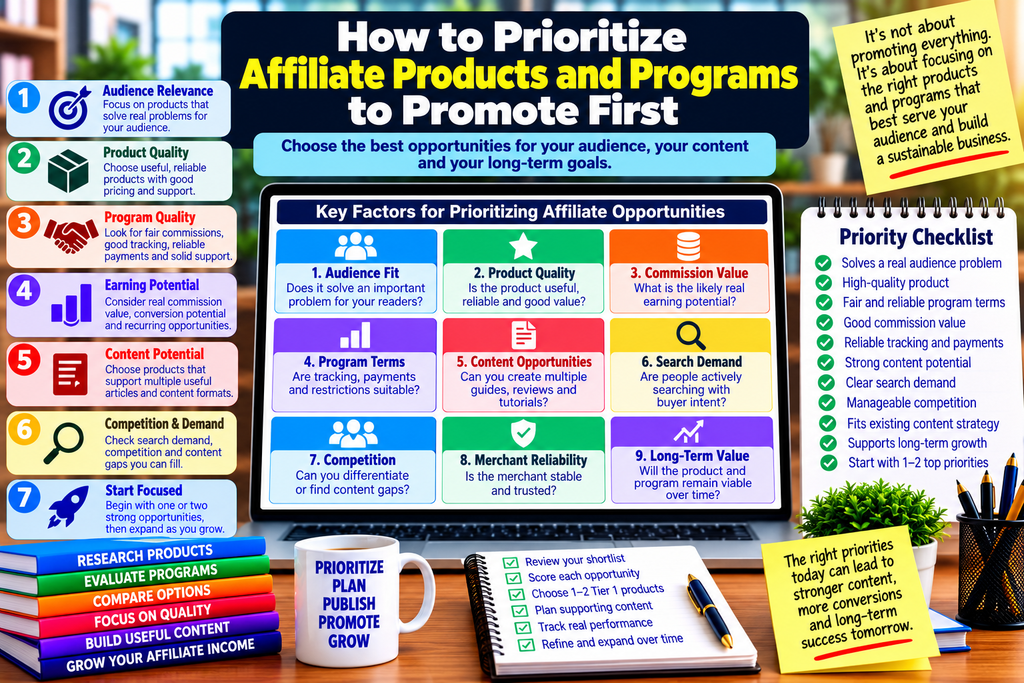
A better approach is to prioritize affiliate products and programs according to their strategic value.
That means looking beyond commission percentage and considering:
- audience fit,
- product quality,
- merchant reliability,
- content potential,
- competition,
- tracking,
- earning potential,
- and long-term usefulness.
The goal is not to identify one universally “best” offer.
It is to decide which opportunities deserve your attention first.
If you are still learning the underlying business model, our guide to what is affiliate marketing explains how affiliates, merchants, referrals, tracking, and commissions work together.
Start With Audience Relevance
Audience fit should be the first filter.
Ask:
- Does the product solve a real problem?
- Is that problem important to the audience?
- Is the product appropriate for their experience level?
- Is the price realistic?
- Does the product fit naturally into the content you already publish?
A high-paying product that does not fit the audience should usually move down the priority list.
The strongest affiliate opportunities tend to feel relevant before they feel commercial.
This priority process builds naturally on understanding how to choose an affiliate offer in the first place, where audience relevance and product quality come before headline commission rates.
Use Your Existing Niche Research
If you have already followed the process in How to Choose the Right Affiliate Marketing Niche, you should have a clear picture of:
- who the audience is,
- what they want,
- what they buy,
- and what problems matter most.
If you have also completed How to Validate an Affiliate Marketing Niche Before You Commit, you should have evidence that the market contains enough demand and commercial potential.
Those two pieces of research should guide product priority.
Separate “Good Product” From “Good Priority”
A product can be excellent and still not deserve immediate promotion.
For example, it may:
- fit a later stage of the buyer journey,
- require more research,
- have limited search demand,
- be too advanced for your current audience,
- or need supporting tutorials before a review makes sense.
That does not make it a bad product.
It simply means the timing may be wrong.
Rank by Problem Importance
Products solving urgent or recurring problems usually deserve greater attention.
Consider whether the product helps the audience:
- save significant time,
- reduce cost,
- make money,
- solve a recurring frustration,
- complete an important task,
- avoid a serious mistake.
Products connected to stronger problems often generate stronger buyer intent.
Rank by Product Quality
Do not promote weak products simply because the affiliate terms are attractive.
Use How to Research Affiliate Products Before You Promote Them to assess:
- usefulness,
- pricing,
- support,
- customer feedback,
- refund policies,
- merchant reputation.
High-quality products should rise toward the top of the list.
Rank by Program Quality
A good product can have a weak affiliate program.
Use How to Evaluate an Affiliate Program Before Joining to compare:
- commissions,
- tracking,
- payment terms,
- restrictions,
- affiliate support,
- merchant reliability.
Strong product plus strong program is the ideal combination.
Whether the program operates through a network or directly with the merchant can also matter, as explained in our guide to affiliate networks vs independent affiliate programs.
Compare Programs Side by Side
When several opportunities look promising, use the framework in How to Compare Affiliate Programs Side by Side.
Compare them on the same criteria.
This prevents one attractive feature — such as a high commission — from dominating the decision.
Consistency makes trade-offs easier to see.
Consider One-Time and Recurring Revenue
Recurring programs can be attractive because a single customer may generate multiple commissions.
But recurring revenue depends on retention.
One-time offers may provide:
- faster cash flow,
- higher upfront commissions,
- simpler tracking.
Recurring vs One-Time Affiliate Commissions explains why both models can have a place.
Do not automatically prioritize recurring programs.
Prioritize the ones that combine good customer value with realistic retention.
Look at Real Commission Value
A commission percentage alone can be misleading.
Compare:
Product A
50% of $20 = $10
Product B
20% of $200 = $40
Product B has the lower percentage but the larger payout.
Also consider:
- average order value,
- upsells,
- renewals,
- refunds.
The real question is:
What is the likely net value of a conversion?
Consider Conversion Potential
A high-paying product is not useful if almost nobody buys it.
Where available, look at:
- conversion rate,
- EPC,
- average order value,
- approval rate,
- reversal rate.
Our guide to Affiliate Marketing Metrics That Actually Matter explains why these figures can be more useful than commission percentage alone.
Consider Tracking Quality
Tracking should influence priority.
A program with:
- reliable links,
- clear attribution,
- transparent reporting,
- reasonable cookie duration
may be easier to work with than one offering a slightly better commission but poor tracking.
Affiliate Marketing Tracking Explained covers these factors in more detail.
Check Payment Accessibility
Before prioritizing an offer, confirm that you can actually receive the money.
Check:
- payment methods,
- payout threshold,
- payment schedule,
- country eligibility,
- tax requirements.
A high-value program is useless if payment access is impractical.
Consider Merchant Reliability
Reliable merchants deserve more weight.
Look for:
- stable products,
- active support,
- clear communication,
- consistent payments,
- reasonable policies.
A smaller commission from a reliable merchant may be preferable to a higher commission from an unstable one.
Consider Content Potential
Some products support many useful articles.
Others support only one.
A strong product may allow you to create:
- review,
- tutorial,
- comparison,
- alternatives article,
- buyer guide,
- troubleshooting article.
That makes the opportunity more valuable.
This connects directly with Affiliate Marketing Content That Converts.
Rank by Content Depth
Ask:
How many genuinely useful articles could I create around this product?
A product with multiple content angles can generate:
- more internal links,
- more search opportunities,
- more reader touchpoints,
- more conversion paths.
That may justify higher priority.
Consider Search Demand
Check whether people actively search for:
- the product,
- reviews,
- comparisons,
- alternatives,
- tutorials,
- pricing.
A product with clear search demand may deserve priority.
But do not chase volume blindly.
Commercial intent matters.
Evaluate Buyer Intent
High-intent searches may include:
- Product X review,
- Product X vs Product Y,
- Product X alternatives,
- Product X pricing,
- best tools for X.
These may indicate readers closer to a purchase decision.
Products associated with strong buyer intent can be attractive early priorities.
Consider Competition
A product may be extremely popular but heavily covered.
That does not make it unsuitable.
Ask whether you can differentiate.
Can you provide:
- a better tutorial,
- a clearer review,
- a more useful comparison,
- a more specific audience angle?
Strong competition may simply mean you need better positioning.
Look for Content Gaps
Sometimes the best opportunity is not the most popular product.
It is the product with poor existing coverage.
Look for:
- outdated reviews,
- weak tutorials,
- generic comparisons,
- missing use cases.
Those gaps may create easier entry points.
Consider Your Existing Content
A product that connects naturally with articles already on the site may deserve higher priority.
If you already have strong content around:
- email marketing,
- automation,
- WordPress,
- SEO,
- affiliate tracking,
then related products may be easier to introduce.
Existing topical relevance reduces the amount of groundwork required.
Look at Internal-Link Opportunities
A product should fit into the content ecosystem.
Ask:
- Which existing articles could link to it?
- Which new articles could support it?
- Does it strengthen an existing cluster?
Good internal-link potential increases strategic value.
Consider Whether the Offer Fits Naturally
If the product requires constant sales language to make it seem relevant, that is a warning sign.
The approach described in How to Promote Affiliate Offers Without Sounding Salesy works best when the product genuinely belongs in the discussion.
Natural fit should influence priority.
Prioritize Trust
Products that are easy to recommend honestly deserve more attention.
Ask:
- Can I explain the strengths clearly?
- Can I acknowledge limitations?
- Would I feel comfortable recommending it to a reader?
- Does the merchant behave professionally?
Trust compounds over time.
A short-term commission is not worth damaging credibility.
Consider Audience Stage
Different products may suit different stages.
A beginner audience may need:
- simpler tools,
- lower pricing,
- basic tutorials.
An advanced audience may value:
- automation,
- analytics,
- premium software,
- specialist tools.
Prioritize products that match the audience you currently serve.
Consider Pricing Friction
Higher-priced products often require more consideration.
That can mean:
- longer sales cycles,
- lower conversion rate,
- more comparison research.
Lower-priced products may convert more easily but produce smaller commissions.
Neither is automatically better.
The priority should reflect the audience and content.
Consider Free Trials
Free trials can reduce buying friction.
Products offering:
- free trials,
- freemium plans,
- demos,
- low-risk entry points
may be easier to introduce.
But check whether affiliate credit survives the trial period.
Consider Refund Risk
High refunds can reduce real earnings.
Check:
- refund window,
- cancellation rates,
- reversal rules.
Net commissions matter more than gross commissions.
Consider Long-Term Customer Value
Subscription products can become more valuable over time.
If customers:
- stay subscribed,
- upgrade,
- buy add-ons,
the long-term value may be strong.
But only if retention is healthy.
Consider Program Stability
Programs change.
Look for evidence of:
- stable commissions,
- consistent tracking,
- reliable payments,
- reasonable communication.
A program with a long track record may deserve priority over a new program with uncertain terms.
Check Whether the Merchant Supports Affiliates Well
Good affiliate support can reduce friction.
Look for:
- responsive managers,
- useful documentation,
- promotional materials,
- technical help,
- clear program updates.
Support may not seem important until something goes wrong.
Consider Geographic Reach
A program may be strong but serve only certain markets.
Ask whether the product is available where your audience lives.
Geographic mismatch can reduce conversion potential.
Consider Mobile Experience
If much of your traffic is mobile, prioritize products with good mobile pages and checkout.
Poor mobile UX can waste good referrals.
Prioritize Products That Strengthen the Site
The best offer is not always the one that pays most.
Sometimes the better priority is the product that helps you build:
- stronger tutorials,
- useful comparisons,
- better buyer guides,
- more complete topic coverage.
That strengthens the publication as a whole.
Use a Simple Priority Score
You can score each opportunity from 1 to 5 on:
Audience Fit
Product Quality
Program Quality
Commission Value
Tracking
Merchant Reliability
Content Potential
Search Demand
Competition Opportunity
Long-Term Value
The total score creates a rough ranking.
It should guide judgment, not replace it.
Weight Important Factors
Some factors matter more than others.
You might use:
Audience fit – 20%
Product quality – 20%
Program quality – 15%
Content potential – 15%
Commission value – 10%
Tracking – 10%
Merchant reliability – 5%
Competition opportunity – 5%
You can adjust the weighting.
The important thing is consistency.
Create Priority Tiers
A useful system is:
Tier 1 — Promote First
Strong audience fit, quality product, reliable program, good content potential.
Tier 2 — Develop Later
Good opportunity but needs more supporting content or research.
Tier 3 — Monitor
Interesting but uncertain.
Reject
Poor fit, weak product, unreliable program, or unacceptable terms.
This prevents every offer from feeling equally urgent.
Start With One or Two Tier 1 Products
Do not try to promote ten programs at once.
A focused start makes it easier to:
- create deeper content,
- track results,
- understand the audience,
- refine positioning.
Expand once you have evidence.
Add Priority Products to the Editorial Calendar
Use your affiliate marketing editorial calendar to schedule content around the strongest offers.
For example:
Week 1 — tutorial
Week 2 — comparison
Week 3 — review
Week 4 — alternatives article
This creates a deliberate content sequence.
Use Content Strategy to Guide the Order
Your affiliate marketing content strategy should determine which product content makes sense next.
A product may deserve Tier 1 status but still need:
- educational context,
- supporting guides,
- a comparison page
before a review.
Priority does not always mean “publish the review tomorrow.”
It means “this deserves focused attention.”
Understand How Affiliate Marketing Actually Works
Understanding how affiliate marketing actually works helps you see that product priority affects the entire journey:
content → click → tracking → merchant page → conversion → commission.
Every stage matters.
Use Data After You Publish
Initial priority is based on research.
Later priority should be influenced by real performance.
Track:
- clicks,
- conversions,
- EPC,
- revenue per page,
- reversals,
- retention.
A product that performs well deserves more supporting content.
A product that performs poorly may deserve less attention.
Do Not Overreact to Early Results
A new article may take time to gain traffic.
Do not abandon a product after a few days.
Look for meaningful trends.
Reprioritize Periodically
Markets change.
Products improve.
Programs cut commissions.
New competitors appear.
Review your priority list occasionally.
An offer that was Tier 1 six months ago may no longer deserve that position.
Avoid Common Prioritization Mistakes
Common affiliate marketing mistakes include:
- prioritizing commission over fit,
- promoting too many offers,
- ignoring program terms,
- chasing trends,
- relying on one merchant,
- ignoring performance data.
A structured process helps avoid these mistakes.
A Practical Priority Checklist
Before placing an offer in Tier 1, ask:
Audience
- Does it solve an important problem?
- Is it appropriate for the reader?
Product
- Is it high quality?
- Is the pricing fair?
- Is support credible?
Program
- Are tracking and payments reliable?
- Are the terms practical?
Content
- Can I create several useful articles?
- Does it fit existing topic clusters?
Economics
- Is the real commission value reasonable?
- Are reversals manageable?
Long-Term
- Is demand durable?
- Is the merchant stable?
- Is there room to expand?
If most answers are yes, the offer deserves serious priority.
Final Thoughts
Learning how to prioritize affiliate products and programs helps turn a long list of opportunities into a focused plan.
You do not need to promote everything.
You need to identify the offers that best combine:
- audience relevance,
- product quality,
- strong program terms,
- useful content potential,
- realistic earning potential,
- and long-term stability.
Then concentrate your effort there.
That usually produces better content, clearer recommendations, easier tracking, and stronger trust than spreading attention across every affiliate opportunity you find.