Choosing and validating a niche is only part of the job.
Once you know the market is worth pursuing, the next question is practical:
Where do you actually find the products and affiliate programs to promote?
Learning how to find affiliate products and programs systematically can save a great deal of time.
Instead of joining the first program you see, the goal is to build a shortlist of credible products and merchants that genuinely fit your audience.
That shortlist then becomes the basis for reviews, comparisons, tutorials, buyer guides, and other commercial content.
If you are still learning the overall business model, our guide to what is affiliate marketing explains how affiliates, merchants, customers, tracking, and commissions fit together.
Start With the Audience Problem
The easiest way to find relevant products is to begin with the problem rather than the product.
Ask what your audience is trying to:
- solve,
- improve,
- simplify,
- learn,
- automate,
- compare,
- or purchase.
Products should enter the picture because they help with those needs.
For example, if the audience wants to build an email list, possible product categories might include:
- email marketing software,
- landing-page tools,
- form builders,
- lead-magnet tools,
- automation software.
Starting with the problem keeps product discovery relevant.
Use Your Niche Research as a Starting Point
If you have already completed the process in How to Choose the Right Affiliate Marketing Niche, you should already have some idea of:
- who the audience is,
- what they need,
- what they buy,
- and what kinds of solutions exist.
If you have gone further and completed How to Validate an Affiliate Marketing Niche Before You Commit, you may also have identified several merchants, products, and commercial search terms.
That research should now become your starting product list.
Search Google for Direct Affiliate Programs
One of the simplest methods is still one of the most effective.
Search for combinations such as:
product category + affiliate program
brand name + affiliate program
software type + partner program
product type + referral program
Many merchants operate their own independent affiliate programs.
Their program pages may explain:
- commissions,
- cookie duration,
- payment methods,
- application process,
- promotional restrictions,
- and affiliate support.
Search the Merchant Website Directly
If you already know a brand you would like to investigate, visit its website.
Look in the footer for terms such as:
- Affiliate Program
- Partners
- Partner Program
- Referrals
- Become an Affiliate
- Ambassador Program
Some merchants do not make their affiliate program prominent.
You may need to search the site or contact support.
Do Not Assume Every Product Has a Program
A product can be popular without offering affiliate commissions.
Some companies run referral programs that reward customers rather than professional affiliates.
Others discontinue programs without much notice.
Always verify that the program is active and that its terms are current.
Search Affiliate Networks
Affiliate networks connect publishers with multiple merchants.
They can be useful because one account may provide access to many programs.
Popular networks differ by niche, region, product type, and merchant.
Networks may provide:
- searchable merchant directories,
- tracking,
- reporting,
- payment processing,
- application management.
Our guide to affiliate networks vs independent affiliate programs explains how network-based programs differ from direct merchant relationships.
Search by Product Category Inside Networks
Once you have access to a network, search by category rather than randomly browsing.
For example:
- software,
- business services,
- finance,
- education,
- health,
- home,
- travel.
Then narrow the list based on audience fit.
The objective is not to join as many programs as possible.
It is to identify the most relevant ones.
Use Digital Product Marketplaces
Some niches are well represented in marketplaces focused on:
- courses,
- software,
- ebooks,
- memberships,
- digital services.
These can reveal products you might not discover through normal search.
However, quality can vary significantly.
Marketplace availability should never replace product research.
Use How to Research Affiliate Products Before You Promote Them before making any recommendation.
Look for Recurring Subscription Products
Recurring programs can be attractive in niches involving:
- software,
- memberships,
- hosting,
- subscriptions,
- services.
Search specifically for:
niche + recurring affiliate program
or:
product category + recurring commissions
Then examine the terms carefully.
As explained in Recurring vs One-Time Affiliate Commissions, recurring revenue depends on customer retention, not simply the advertised percentage.
Search for SaaS Partner Programs
Software-as-a-Service companies often use terms such as:
- partner program,
- referral partner,
- affiliate partner,
- solutions partner.
If your niche involves business tools, software, automation, marketing, productivity, or technology, SaaS companies can provide a rich source of affiliate opportunities.
Use Competitor Websites for Discovery
Competitor research can reveal products already being promoted in your niche.
Look at:
- review pages,
- comparison articles,
- resource pages,
- recommended tools,
- tutorials,
- disclosures.
You are not looking to copy their selections.
You are using them to identify products worth investigating independently.
Look at Which Products Appear Repeatedly
If several credible publishers repeatedly mention the same product, that may indicate:
- strong demand,
- good affiliate availability,
- active merchant promotion,
- or strong customer recognition.
It does not automatically mean the product is good.
But it may deserve further research.
Search for Product Reviews
Review searches can reveal both products and alternatives.
Try searches such as:
best tools for [audience]
best [product category]
[product] review
[product] alternatives
This may uncover competitors you had not considered.
Search Comparison Queries
Queries such as:
Product A vs Product B
can quickly reveal the main competitors in a category.
Those competitors may each have affiliate programs.
Comparison research is especially useful when building a broader shortlist.
Use Buyer Guides for Discovery
Buyer guides often gather many products in one place.
Examples include:
- best email platforms,
- best hosting services,
- best SEO tools,
- best course platforms.
These pages can be useful for identifying names.
But do not treat another publisher’s ranking as evidence that the products deserve promotion.
Research them independently.
Search YouTube
YouTube can reveal which products are actively being demonstrated and discussed.
Look for:
- reviews,
- tutorials,
- comparisons,
- setup guides,
- product walkthroughs.
This can also help you evaluate whether the product has enough depth to support your own tutorial content.
Search Reddit and Forums
Community discussions can reveal products that ordinary search results miss.
Look for questions such as:
- What tool do you recommend?
- What are you using?
- What is the best alternative?
- Why did you switch?
- Which product is worth paying for?
Community discussions can reveal both product names and recurring complaints.
Look at Industry Newsletters
Specialist newsletters often mention:
- new products,
- established tools,
- partnerships,
- industry leaders,
- new pricing models.
These can help you discover opportunities before they become widely discussed.
Check Resource Pages
Some publishers maintain:
- recommended tools pages,
- resource libraries,
- software stacks,
- favourite products lists.
These can provide useful discovery leads.
Again, treat them as starting points rather than endorsements.
Search the Product Name Plus “Affiliate”
Once you identify a product, search:
Product Name affiliate
Product Name affiliate program
Product Name partner program
This often reveals whether the program exists and whether it runs independently or through a network.
Search the Company Name Plus “Partners”
Some companies avoid the word “affiliate.”
Their programs may sit under:
- partnerships,
- ambassadors,
- referrals,
- creators,
- publishers.
Searching multiple terms can uncover hidden opportunities.
Contact the Merchant
If you cannot find a program but the product looks highly relevant, contact the company.
Ask whether they:
- have an affiliate program,
- operate a referral program,
- work with publishing partners.
Some programs are private or invitation-only.
Others may be available but poorly advertised.
Look for Products With Strong Content Potential
A good affiliate product should give you multiple ways to create useful content.
Possible formats include:
- review,
- tutorial,
- comparison,
- buyer guide,
- alternatives article,
- troubleshooting guide.
This connects directly with Affiliate Marketing Content That Converts.
Products that support several useful content formats often provide more long-term value than products you can mention only once.
Look for Products That Fit Naturally
A product should feel like a natural solution inside your content.
If every mention feels forced, the fit may be weak.
The principles in How to Promote Affiliate Offers Without Sounding Salesy apply here.
The best product opportunities usually emerge from genuine reader needs.
Build a Product Discovery Spreadsheet
As you find potential products, record them.
Useful fields might include:
- product,
- merchant,
- category,
- audience fit,
- program URL,
- commission type,
- commission rate,
- cookie duration,
- payment method,
- program status,
- notes.
This prevents repeated research and makes comparison easier.
Separate Product Discovery From Product Approval
Finding a product is not the same as deciding to promote it.
Use two stages:
Discovery
Find promising products.
Evaluation
Research whether they deserve promotion.
That separation helps prevent enthusiasm from replacing judgment.
Research the Product Before Joining
Before applying to the program, examine:
- product quality,
- pricing,
- customer reviews,
- support,
- refund policy,
- merchant reputation.
Our guide to How to Research Affiliate Products Before You Promote Them provides the full research process.
Evaluate the Program Separately
A good product can still have a poor affiliate program.
Once the product passes your research, use How to Evaluate an Affiliate Program Before Joining to examine:
- tracking,
- payout terms,
- restrictions,
- support,
- merchant reliability,
- geographic eligibility.
Treat product quality and program quality as two separate decisions.
Compare Programs Side by Side
If several products look promising, use the same criteria for each.
Our guide to compare affiliate programs explains how to compare:
- commissions,
- tracking,
- payments,
- restrictions,
- merchant quality,
- support,
- long-term value.
This helps prevent one flashy feature from dominating the decision.
Check How Affiliate Marketing Actually Works
Understanding how affiliate marketing actually works makes it easier to evaluate the full path from affiliate link to sale.
That includes:
- tracking,
- cookies,
- attribution,
- conversions,
- commissions.
The more you understand the process, the easier it becomes to identify weak programs.
Check Tracking Terms
Never assume tracking is standard.
Use Affiliate Marketing Tracking Explained to help evaluate:
- cookie duration,
- attribution model,
- reporting,
- referral links.
A strong product with weak tracking may be frustrating to promote.
Think About Real Earnings
Do not stop at the commission percentage.
Use the principles in Affiliate Marketing Metrics That Actually Matter to think about:
- conversion rate,
- EPC,
- approval rate,
- reversals,
- retention,
- net earnings.
A lower headline commission can sometimes produce stronger real earnings.
Check Whether the Product Solves the Right Problem
When several products look attractive, return to audience fit.
Ask:
Which one genuinely helps the reader?
This connects with How to Choose an Affiliate Offer.
The strongest offer is not always the highest-paying one.
Avoid Common Discovery Mistakes
Common affiliate marketing mistakes include:
- joining too many programs,
- chasing commissions,
- ignoring audience fit,
- promoting poor products,
- failing to read terms.
A disciplined discovery process reduces these risks.
Do Not Join Everything You Find
More programs create more complexity.
You may end up with:
- scattered content,
- too many dashboards,
- fragmented reporting,
- competing recommendations.
Start with a smaller group of strong offers.
Expand only when there is a clear reason.
Look for Complementary Products
Some products work well together.
For example:
A niche around email marketing might include:
- email platform,
- landing-page tool,
- form builder,
- automation tool.
Complementary products can support a broader content ecosystem.
Avoid Product Conflict
Sometimes two products solve exactly the same problem.
That is not necessarily bad.
It can support comparison content.
But if you recommend many near-identical products without explaining the differences, readers may become confused.
Look for Program Stability
Prefer merchants that appear:
- active,
- well supported,
- transparent,
- professionally managed.
Programs that repeatedly change terms or disappear create maintenance problems.
Check Payment Accessibility
Before investing heavily in a program, confirm you can receive the money.
Look at:
- payment methods,
- minimum thresholds,
- geographic eligibility,
- tax requirements.
This should happen before publishing commercial content.
Check Promotional Restrictions
Some merchants limit:
- email,
- paid search,
- social ads,
- brand bidding,
- coupon promotion,
- direct linking.
Read the terms.
Do not build a promotional strategy around a method the program prohibits.
Keep a Shortlist
A useful process is to maintain three groups:
Approved
Strong product and strong program.
Investigating
Promising but requires more research.
Rejected
Not suitable.
This prevents repeatedly reconsidering weak opportunities.
Add Approved Products to Your Content Plan
Once a product passes research and program evaluation, decide what content should support it.
Possible articles include:
- tutorial,
- review,
- comparison,
- buyer guide.
Add those ideas to your affiliate marketing editorial calendar.
That keeps monetisation aligned with the larger content strategy.
Use Your Content Strategy to Decide Priority
Not every approved product needs immediate coverage.
Your affiliate marketing content strategy should determine which opportunities fit the current topic cluster and publishing priorities.
A product may be good but still belong later in the plan.
Start With the Strongest Fit
When several programs qualify, begin with the one that offers the best balance of:
- audience relevance,
- product quality,
- commercial value,
- content potential,
- merchant reliability.
This gives you a clearer starting point.
Test the Product Through Content
After publishing, watch what happens.
Do readers:
- click,
- engage,
- convert,
- return?
Real behaviour can help validate the product opportunity.
Do Not Expect Immediate Results
New affiliate content may take time to:
- be indexed,
- attract traffic,
- generate clicks,
- generate sales.
Give the content enough time before drawing conclusions.
Update Your Product List
Affiliate opportunities change.
Merchants:
- launch new products,
- close programs,
- change commissions,
- alter tracking,
- introduce new restrictions.
Review your shortlist periodically.
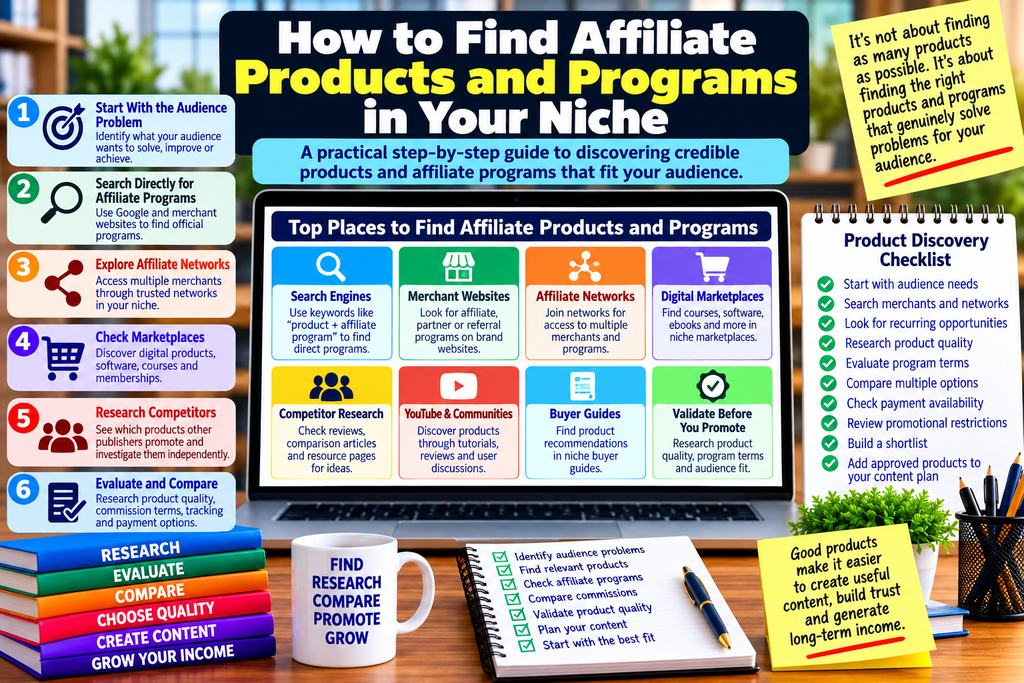
A Simple Product Discovery Process
A practical workflow might be:
1. Identify the audience problem.
2. List product categories that solve it.
3. Search merchants directly.
4. Search affiliate networks and marketplaces.
5. Study competitor and community recommendations.
6. Build a shortlist.
7. Research the products.
8. Evaluate the programs.
9. Compare the strongest opportunities.
10. Add approved products to your editorial plan.
That process is far more reliable than joining programs randomly.
Final Thoughts
Learning how to find affiliate products and programs is not about discovering the largest possible number of offers.
It is about building a smaller, stronger collection of opportunities that fit:
- your audience,
- your niche,
- your content,
- your traffic methods,
- and your long-term strategy.
Start with the problem.
Find the products.
Research them.
Evaluate the programs.
Compare the alternatives.
Then build content around the offers that genuinely deserve attention.
That approach takes more effort than grabbing the first affiliate link you find.
But it gives you a much stronger foundation for sustainable affiliate marketing.